
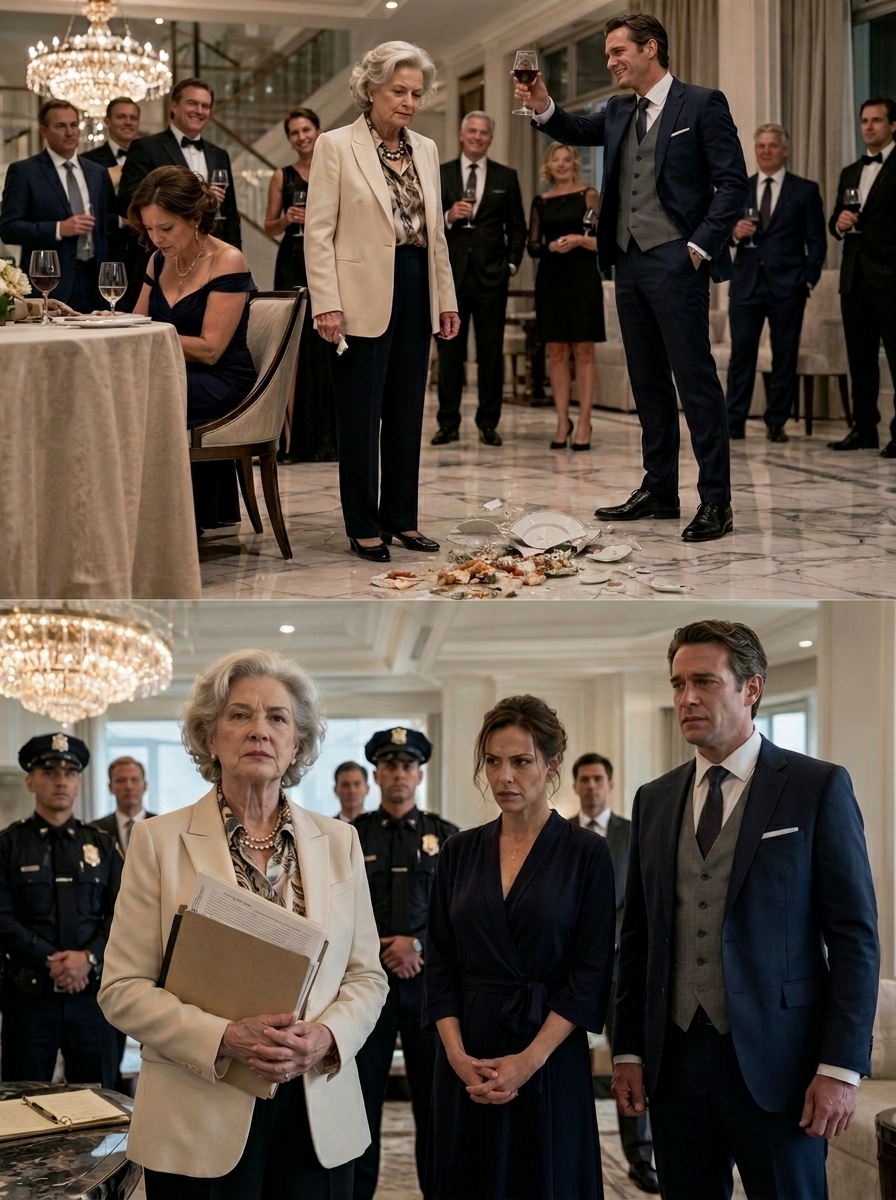
The gravy splashed across the marble floor a split second before my plate shattered. For one suspended breath, the entire dining room fell silent, as though even the chandeliers above us had stopped breathing.
Then my son-in-law laughed.
“If you want dinner,” Victor said, lifting his wineglass with a grin, “lick it off the floor.”
My daughter Claire lowered her eyes to her lap. Not toward me. Not toward the shattered porcelain. Toward her lap, where her fingers twisted a napkin so tightly it looked like a rope.
Around the table, Victor’s friends smirked inside their expensive suits. His mother lifted a hand to her mouth, but I still saw the smile hiding beneath the diamonds.
The evening was supposed to celebrate Victor’s newest announcement. He had just declared that he was “expanding” his luxury real estate company. He stood at the head of the table inside my late husband’s house, drinking my late husband’s wine, wearing the watch my daughter purchased for him with money I had given her.
And he had slapped my plate from my hands because I refused to raise a toast to him.
“Come on, Margaret,” he said smoothly, poison wrapped in charm. “Don’t be dramatic. You’re living here rent-free, eating food I pay for.”
I looked down at the roast scattered across the floor. At the dark red wine spreading over the white marble like blood.
At my daughter’s pale face.
“I paid for this house,” I said quietly.
Victor leaned forward. “Not anymore.”
Several people laughed softly.
For two years, he had been working on Claire piece by piece. Tiny comments. Tiny papers. Tiny emergencies. First he convinced her I was lonely. Then forgetful. Then unstable. Then expensive. Lately, Claire had started bringing me documents “to make things easier.” I smiled, adjusted my reading glasses, and signed absolutely nothing.
Victor believed grief had softened me.
He believed old age had made me harmless.
He believed a widow in a black coat could be cornered and forgotten there.
I stood slowly. My knees ached, but my spine stayed straight. I removed the napkin from my lap, placed it beside the broken plate, and adjusted my coat carefully.
Victor’s grin widened. “Leaving already?”
I looked directly into his eyes.
Then I said three words.
“You’re under investigation.”
The wineglass slipped in his hand. Red wine splashed down the front of his shirt.
For the first time all night, Victor looked frightened.
I walked out before anyone could stop me. Behind me, Claire whispered softly, “Mom?”
I didn’t turn around.
Not yet…
The following morning, Victor called me seventeen times.
I ignored every single call.
By noon, the text messages started arriving.
You misunderstood.
Don’t upset Claire.
We should talk like family.
That last one made me laugh.
Family.
Victor used that word like a weapon. Family meant I should stay quiet while he moved company documents into my home office. Family meant I should ignore the young assistant who left his company crying. Family meant I should smile politely while he bragged about “investors” whose names never appeared anywhere publicly.
Family meant surrender.
But before I became a widow wrapped in black coats, I spent thirty-two years working as a forensic accountant. I tracked stolen money through shell corporations, fake invoices, and offshore accounts. Men like Victor always believed cruelty was power.
It wasn’t.
Cruelty was noise.
Paper was power.
And I had paper.
Three months earlier, I discovered a folder hidden behind a loose wall panel inside my late husband’s study. Victor had been using Claire’s name to move money through fake renovation contracts. My daughter had signed documents she believed were routine household approvals. He had tied her to financial fraud like a stone chained around her neck.
That was when I stopped being a grieving widow and became a witness.
I copied everything.
Bank records.
Emails.
Security audio Victor forgot existed.
Video footage of him threatening a contractor in my driveway.
A recording of him telling his attorney, “Once the old woman signs, we control the trust.”
The old woman.
I remember making tea after hearing that line. My hands never trembled once.
At three in the afternoon, Victor arrived at my guesthouse without knocking.
Two men came with him.
“Margaret,” he said, smiling too hard, “you’ve embarrassed yourself enough.”
“I’m busy.”
He stepped inside anyway. “You’re confused. You’re angry. Claire mentioned you’ve been behaving strangely.”
“She told you that?”
Something flickered across his face.
I slowly set my tea cup down. “Interesting.”
One of the men opened a leather folder. “Mrs. Hale, we’ve prepared paperwork for a medical guardianship review.”
Victor’s smile returned instantly. “For your own safety.”
There it was.
The next step.
Declare me incompetent. Take my house. Silence me. Blame everything on dementia.
I almost admired how quickly he moved.
Almost.
“You should leave,” I said calmly.
Victor stepped closer. His cologne filled the room like smoke. “Listen carefully. You’re old. Claire is weak. I’m the only person in this family who knows how to win.”
I glanced toward the tiny camera hidden on the bookshelf behind a ceramic dove.
“You always talk too much,” I replied.
His expression hardened. “What did you say?”
I stood and slowly opened my coat.
Pinned inside was my old federal consultant badge, renewed six weeks earlier for a financial crimes task force.
Victor stared at it.
I smiled faintly.
“You targeted the wrong woman.”
By sunset, the dining room was crowded again.
Not with guests this time.
With lawyers.
Victor arrived furious, dragging Claire beside him like she was another expensive accessory. His mother followed behind, wrapped in diamonds and panic. Two police officers stood near the front door. My attorney sat at the table with three perfectly organized folders in front of him.
Victor stopped cold when he saw them.
“What is this?” he snapped.
“A family meeting,” I answered calmly.
Claire looked at me, her eyes swollen and red. “Mom, what’s happening?”
I reached for her hand. She flinched first, then held on tightly.
Victor pointed at me. “She’s manipulating you.”
“No,” I said quietly. “You did that.”
My attorney opened the first folder. “Mr. Cole, we possess evidence that you forged investor disclosures, misused trust-related accounts, and created fraudulent renovation contracts under your wife’s name.”
Victor laughed once. “That’s ridiculous.”
Then the second folder opened.
Emails.
Transfers.
Signatures.
Dates.
His laughter disappeared.
His mother whispered shakily, “Victor…”
Then I pressed play on the recording.
“Once the old woman signs, we control the trust.”
The entire room turned cold.
Claire’s hand shook violently inside mine. “You used me?”
Victor turned toward her immediately. “Don’t be stupid. Everything I did was for us.”
“No,” I said softly. “Everything you did was for yourself.”
He lunged toward the table, but one of the officers stepped forward immediately.
My attorney continued speaking, calm and precise. “Additionally, Mrs. Hale’s trust has already filed civil action to recover losses. Your business accounts have been frozen pending investigation. Your largest investor withdrew this morning. Your licensing board received evidence earlier today.”
Victor’s face lost every trace of color.
“You can’t do that,” he whispered.
I glanced toward the faint stain still visible on the marble floor where my dinner had fallen the night before.
“I did something worse,” I replied.
His eyes snapped toward mine.
“I protected my daughter before you could destroy her.”
Claire started crying, but this time she didn’t lower her head. Instead, she removed her wedding ring and placed it gently on the table.
Victor stared at it like it was a bullet aimed directly at him.
“You’ll regret this,” he hissed.
“No,” Claire said, her voice breaking but steady. “I already regret marrying you.”
That was the moment he finally broke.
Not from anger.
From fear.
Real fear.
The kind arrogant men feel when the world suddenly stops bending for them.
Two weeks later, Victor was arrested for fraud and coercive financial abuse. His company collapsed before the month ended. His mother sold her diamonds to pay attorneys who still couldn’t save him. The friends who laughed while he humiliated me disappeared faster than smoke.
Six months later, Claire and I sat together in that same dining room eating dinner.
No glittering chandeliers.
No strangers.
No cruelty disguised as charm.
Just soup, warm bread, and peace.
Claire reached across the table and squeezed my hand gently.
“I should have listened,” she whispered.
I looked at my daughter — alive, free, sunlight soft across her face.
“You’re listening now.”
Outside, the garden had started blooming again. Inside, the marble floor shone spotless and bright.
This time, nothing was broken.