
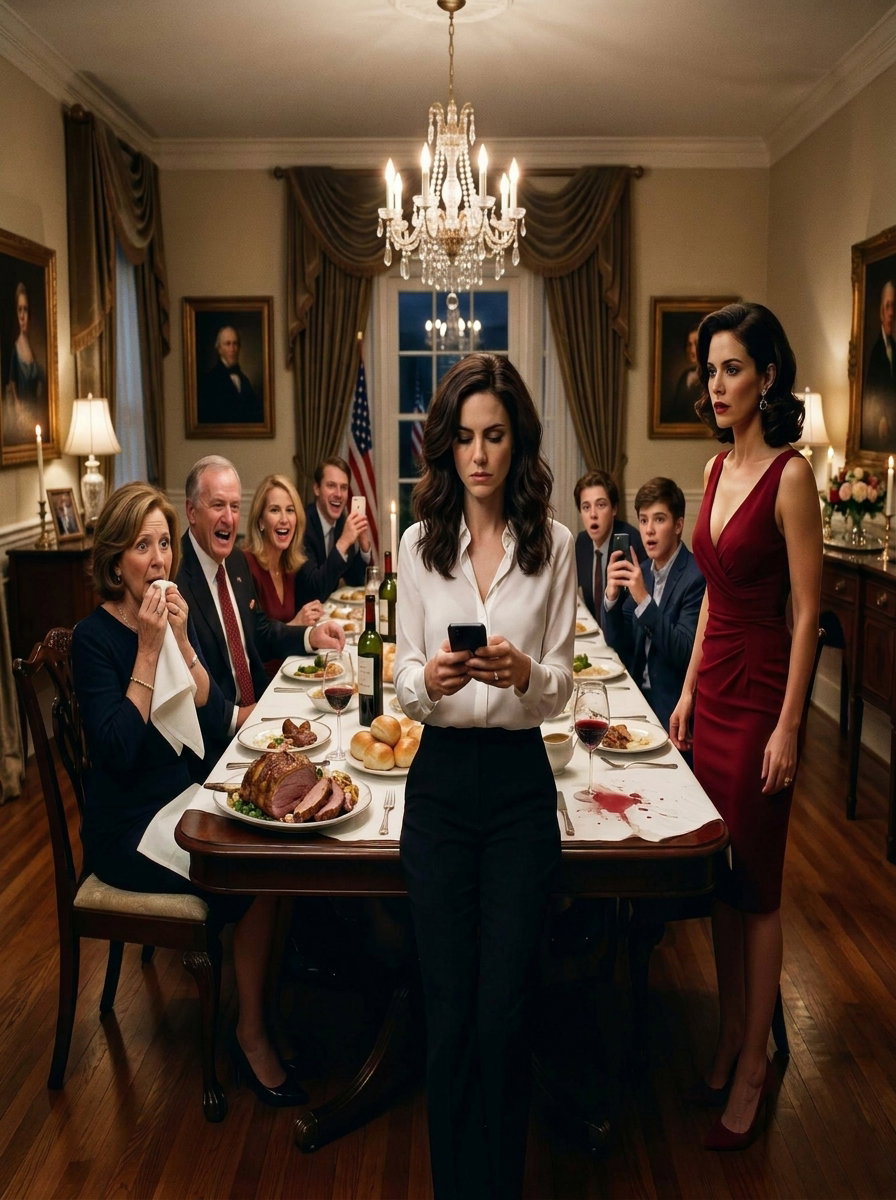
My sister pushed me off my chair during family dinner and told me to eat on the floor — so I smiled, tapped my phone once, and by morning she had called me 73 times.
My sister shoved me out of my chair at family dinner and said, “Get off the table. Eat on the floor.”
My hip struck the hardwood first.
Then my elbow.
Then the whole dining room burst into laughter, as if I had been part of the evening’s entertainment.
My mother laughed so hard she pressed a napkin over her mouth. My father shook his head like I had simply fallen because of my own incompetence. My cousins leaned back in their seats filming, while Vanessa, my sister, stood over me in a red dress, one hand resting on the chair she had just stolen from me.
“Don’t look so shocked,” she said. “You’re used to serving people, aren’t you?”
More laughter followed.
The room smelled of roast lamb, garlic butter, and expensive wine my family had not paid for in years.
I knew that because I had.
Every month.
Quietly.
I paid their utilities, their groceries, my father’s club membership, my mother’s credit cards, and Vanessa’s endless “temporary help” expenses—expenses she called emergencies but treated like lifestyle funding.
Not because they deserved it.
Because before my grandmother died, she made me promise that I would never let the family fall apart financially.
But promises are not built to survive humiliation like that.
That night was supposed to be my father’s birthday dinner.
My mother had called me three separate times to remind me to “dress appropriately” and not “talk too much about work.”
To them, I was still Mia.
The quiet daughter.
The “catering girl.”
What they did not know was that my “little catering business” had become the preferred private dining company for hospitals, law firms, and luxury estates across the city.
What they did not know was that the lamb sitting on their table came from my supplier.
What they did not know was that the wine in their glasses had been billed through my account.
And what they absolutely did not know was that the house they were laughing inside had been seconds away from foreclosure — until I quietly saved it six months earlier.
Vanessa bent down, smiling toward my cousin’s phone camera.
“Come on, Mia,” she said softly. “Crawl back up.”
I looked around the table.
Not one person seemed uncomfortable.
Not even my mother.
Something inside me went completely still.
I pushed myself up slowly, brushed my hands against my pants, and smiled at her.
“Enjoy this dinner,” I said calmly. “It’s your last free one.”
Vanessa’s smile twitched. “What?”
I stood.
Took out my phone.
My mother snapped instantly, “Don’t start being dramatic.”
I did not look at her.
I opened my banking app.
One tap.
Then the family expense dashboard.
Second tap.
Then I pressed call on my attorney.
And I said clearly, loud enough for every person at the table to hear:
“Execute the freeze. All accounts. Effective immediately.”
The room went silent so quickly it felt as if sound itself had been removed.
Vanessa’s face drained of color.
My father slowly lowered his fork.
My mother whispered, “Mia… what did you just do?”
I finally looked at them again.
And smiled.
“Something I should’ve done a long time ago.”
By morning, there were 73 missed calls on my phone.
And for the first time in years…
not one of them was laughing.
Part 2:
The first call came at 6:04 a.m.
Dad.
Then Mom.
Then Vanessa.
Then my uncle, my aunt, two cousins, and a number I recognized as my father’s bank manager.
I drank coffee in my apartment and watched the calls stack up like a storm I had finally stepped out of.
At 8:17, Mom left a voicemail.
“Mia, the grocery account declined. Your father is embarrassed. Call me now.”
At 8:39, Vanessa texted.
My card got frozen at brunch. What did you do?
At 9:12, Dad’s message came through.
The mortgage office says payment was reversed. This better not be your little tantrum.
Little tantrum.
I saved that one.
By noon, they were at my apartment door.
All of them.
Mom was still wearing her silk robe. Dad was unshaven. Vanessa had sunglasses on indoors, as if financial consequences were paparazzi.
I opened the door with the chain still latched.
Dad’s face was red. “Unlock this door.”
“No.”
Mom stepped closer. “Mia, sweetheart, we had a misunderstanding.”
I laughed softly. “I was on the floor. That part was clear.”
Vanessa ripped off her sunglasses. “You froze my cards?”
“My cards,” I said. “Authorized user access revoked.”
Her mouth opened.
Dad pointed at me. “And the house?”
“I stopped paying for it.”
Mom grabbed Dad’s arm. “You can’t. We’ll lose it.”
“You were losing it before I helped.”
The hallway fell silent.
My uncle frowned. “What does that mean?”
I looked at my parents. “Tell them.”
No one spoke.
So I did.
“For three years, I paid the mortgage arrears, utilities, food, insurance, taxes, and everyone’s emergency expenses. Last night, they laughed while Vanessa pushed me onto the floor. So I ended the arrangement.”
Vanessa whispered, “You’re lying.”
I held up my phone with the transaction history open.
My aunt gasped.
Dad’s anger cracked into panic.
Then my attorney stepped out of the elevator behind them, holding a folder.
“Mia,” he said, “the lien notices are filed, the account access is terminated, and the reimbursement demand letters are ready.”
My mother’s face went pale.
Vanessa stared at the folder.
“What reimbursement letters?”
Part 3:
My attorney handed one to my father.
Then one to my mother.
Then one to Vanessa.
“For expenses paid under documented emergency support,” he said. “My client is not seeking repayment for gifts. She is seeking repayment for charges made after written promises to reimburse, including Ms. Vanessa Cole’s personal card spending.”
Vanessa’s voice cracked. “You kept records?”
I looked at her. “I run a business.”
Dad flipped through the pages, his hands shaking. “This is over four hundred thousand dollars.”
“Yes.”
Mom began to cry. “Mia, family doesn’t do this.”
I looked at her silk robe, her diamond bracelet, the woman who had laughed while her daughter hit the floor.
“Family doesn’t tell someone to eat on the floor either.”
The lawsuit never reached trial.
Once my relatives saw the records, the family mythology fell apart quickly. My parents had not been “helping me stay humble.” I had been keeping a roof over their heads. Vanessa had not been “temporarily between opportunities.” She had been living off my credit while calling me servant names at dinner.
The house was sold before foreclosure could happen. My parents moved into a smaller condo. Vanessa’s cards were canceled, her car was repossessed, and she had to sell the red dress she had worn the night she shoved me.
She texted once.
You destroyed us.
I replied once.
No. I stopped funding the destruction.
Then I blocked her.
Six months later, I catered a charity gala at the country club where my father used to brag about “supporting” me. He walked in with my mother, saw my company logo carved into the ice sculpture, and stopped cold.
The chairman shook my hand in front of them. “Mia, your team saved this event.”
My mother looked at the floor.
For one second, I remembered lying there, listening to them laugh.
I smiled, adjusted my headset, and walked past them.
That night, after service, my staff ate together at a long table with hot food, and no one sitting lower than anyone else.
When we raised our glasses, I made the only toast that mattered.
“To paid bills, clean floors, and knowing when to leave the table.”