
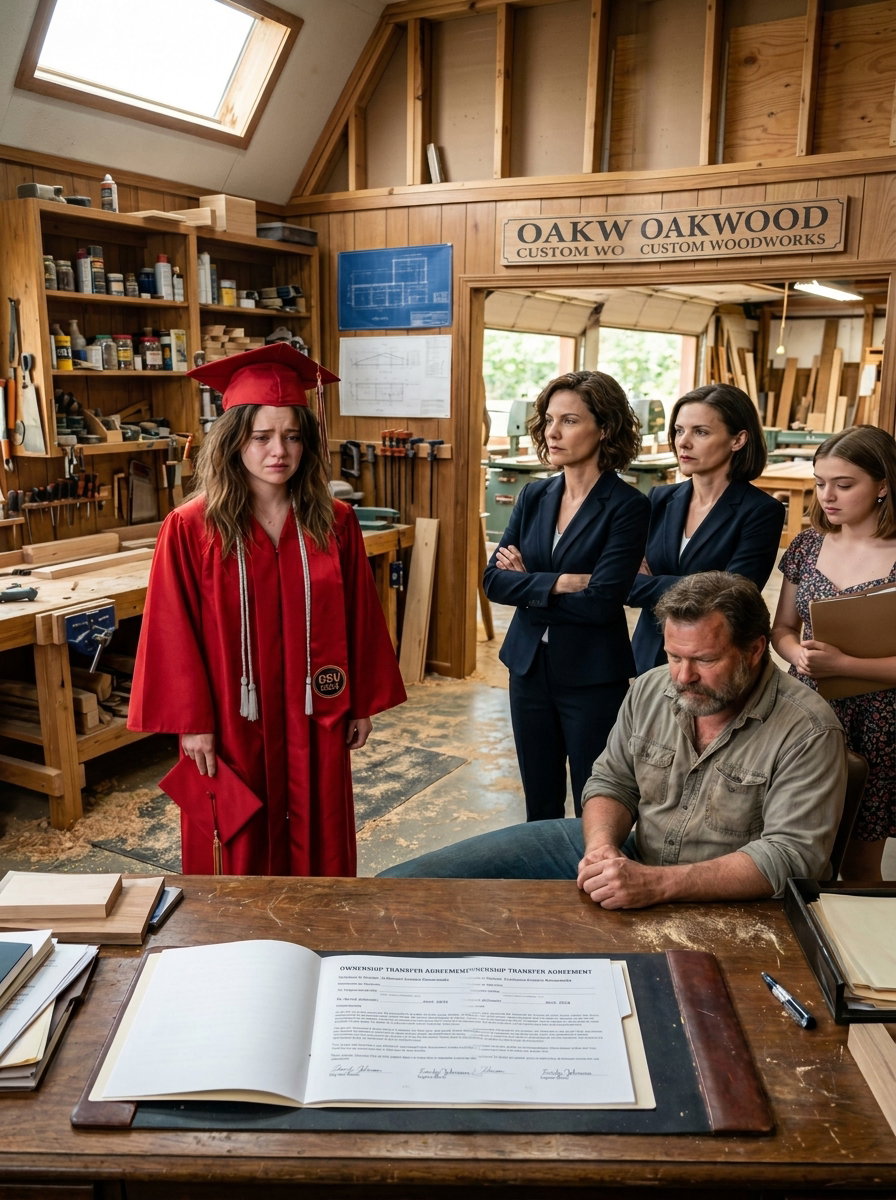
After graduation, I discovered my parents had handed our family business over to my sister. Mom smiled and said, “You’re good with your hands, not your brain.” So I stopped giving them sixty unpaid hours every week and left. Two weeks later, Dad called in a panic: “Our biggest client is leaving.” I smiled and said, “No, Dad. They’re leaving with me.” And that was when everything fell apart.
After graduation, I learned my parents had given our family business to my sister.
Not offered her a position. Not promoted her into management. Given it to her.
I was still in my navy graduation gown when I stepped into the back office of Miller Custom Woodworks and found my parents, my younger sister Paige, and our accountant gathered around Dad’s desk. An open bottle of champagne sat there, four glasses had been poured, and a folder on the desk read “Ownership Transfer Agreement.”
Paige smiled at me as if she had just won a prize. “Surprise.”
I looked at my father. “What is this?”
Dad refused to meet my eyes. Mom did not. She folded her hands together and spoke in that gentle, cutting voice she used whenever she wanted to sound sensible while breaking me down.
“Your sister will be taking over the company.”
I laughed once because I truly thought I had heard wrong. “Paige doesn’t even know how to read a production schedule.”
Paige’s smile faded.
Mom’s eyes turned hard. “Don’t be bitter, Brooke. You’re good with your hands, not your brain.”
The words hit harder than any slap could have.
For six years, I had given that shop sixty unpaid hours a week. I built cabinets, handled urgent orders, corrected client mistakes, trained new workers, and answered emails at midnight because Dad said, “Family pitches in.” I delayed college twice to help when the business nearly failed. Then I finished my degree at night while still keeping the workshop running.
Paige had spent those same years filming lifestyle videos and calling the shop “dusty.”
Dad finally spoke. “Your mother and I think Paige has the image to modernize the brand.”
“The image?” I asked.
Mom nodded. “Clients respond to polish.”
I looked down at my hands, still rough from sanding oak the night before my final exam.
Then I removed my graduation cap and placed it on Dad’s desk.
“You’re right,” I said quietly. “I’m done using my hands here.”
Dad frowned. “Don’t be dramatic. We still need you in production.”
“No,” I said. “You needed me before you gave my work away.”
I walked out while Mom called after me, “You’ll come back by Monday.”
But I did not.
And ten days later, Dad called me, breathing hard.
“Brooke,” he said, “our biggest client just canceled.”
I looked at my silent phone screen and smiled.
“No, Dad,” I said. “They didn’t cancel. They followed me.”
Part 2
Dad went completely quiet.
On the other end of the call, I could hear machines running behind him and Mom whispering, “What did she say?” I pictured them in the office, surrounded by unfinished orders, finally understanding that the person they had dismissed as “hands, not brains” had been carrying the whole company.
“What do you mean they followed you?” Dad asked.
“I mean Hawthorne Hotels called me yesterday,” I said. “They asked if I was still the person managing their custom millwork project. I told them I no longer worked for Miller Custom Woodworks.”
Dad’s voice turned sharp. “You had no right to speak to our client.”
“They called my personal number,” I replied. “Because I’m the one who designed their lobby panels, solved their installation problem, and kept their contract from walking away last winter.”
That contract made up nearly forty percent of the company’s annual revenue. Paige had never sat in on one meeting for it, but I had driven three hours through a snowstorm to fix a measurement error Dad caused. I had rebuilt the entire delivery schedule while studying for a final exam in supply chain management. I had earned that client’s confidence one exhausted day at a time.
Mom took the phone. “Brooke, listen to me. You’re upset. Come in tomorrow and help Paige understand the account.”
I almost laughed. “You want me to train the owner?”
“She’s your sister.”
“And I was your daughter.”
The words escaped before I could stop them, but once they were out, I did not regret them.
Mom lowered her voice. “If this contract falls through, people could lose jobs.”
That hurt, because I cared about the crew. I cared about Luis, who had taught me how to use the old planer safely. I cared about Denise, who packed every shipment like it was going into her own house. I cared about the shop more than Paige ever had.
So I had already made calls.
“I offered every employee a chance to work with me as independent contractors,” I said. “Luis, Denise, and Marco accepted. Hawthorne signed with my new company this morning.”
Dad came back on the line. “Your company?”
“Yes,” I said. “Brooke Miller Design & Build.”
Paige suddenly yelled from somewhere behind him, “She stole it!”
“No,” I said. “I built what you never bothered to learn.”
Dad’s voice cracked with anger. “After everything we gave you?”
I stared at my graduation gown hanging over a chair in my small apartment, still faintly smelling of sawdust.
“You gave Paige the company,” I said. “You gave me permission to stop saving it.”
Then I ended the call.
Part 3
The first month was terrifying.
Starting a business sounds courageous when people retell it later, but in real life, it looks like sleeping four hours a night, checking your bank balance with one eye half closed, and praying the truck does not break down before a delivery. I rented a small workspace on the edge of town, bought used equipment, and worked beside Luis, Denise, and Marco until our hands throbbed.
But this time, every hour meant something.
Hawthorne Hotels loved the finished installation. Their project manager, Mr. Collins, shook my hand in the completed lobby and said, “Brooke, we didn’t hire your family’s company. We hired you. We just didn’t know it yet.”
I had to turn away for a moment because my eyes filled with tears.
Meanwhile, Miller Custom Woodworks began collapsing. Paige changed the logo, fired the receptionist, and promised impossible deadlines to clients she barely understood. Mom kept posting online about “women in leadership,” but behind the scenes, Dad was calling old customers and begging for more time.
Three months later, Dad came to my workshop.
He looked smaller than I remembered, standing in the doorway with sawdust on his shoes and shame in his eyes. “Your mother doesn’t know I’m here.”
I kept sanding the edge of a walnut table. “What do you need?”
He swallowed. “Paige wants to sell the business.”
I stopped moving.
“She says it’s too stressful,” he continued. “Your mother thinks maybe… maybe you could come back. As operations manager.”
I looked around my own shop. Luis was laughing with Marco near the cutting table. Denise was labeling Hawthorne’s next shipment. My company name was painted on the wall, plain and clean.
“No,” I said.
Dad flinched. “Brooke—”
“You didn’t offer me ownership when I earned it,” I said. “You offered me work when you lost control.”
He looked down. “Your mother was wrong.”
I waited.
Finally, he added, “I was wrong too.”
It was the first honest sentence he had given me in years. It mattered. But it did not change my answer.
“I hope you fix what you can,” I said. “But I’m not coming back to be useful and invisible.”
He nodded slowly and left.
A year after graduation, Brooke Miller Design & Build moved into a larger workshop. I hired five full-time employees, paid them fairly, and made one rule clear from the first day: no one works for free just because someone calls them family.
My parents gave Paige a company. But without meaning to, they gave me something better—the courage to create my own.
So tell me honestly—if your family used your talent, dismissed your mind, and handed your work to someone else, would you stay loyal to their business, or would you finally build something with your own name on it?