
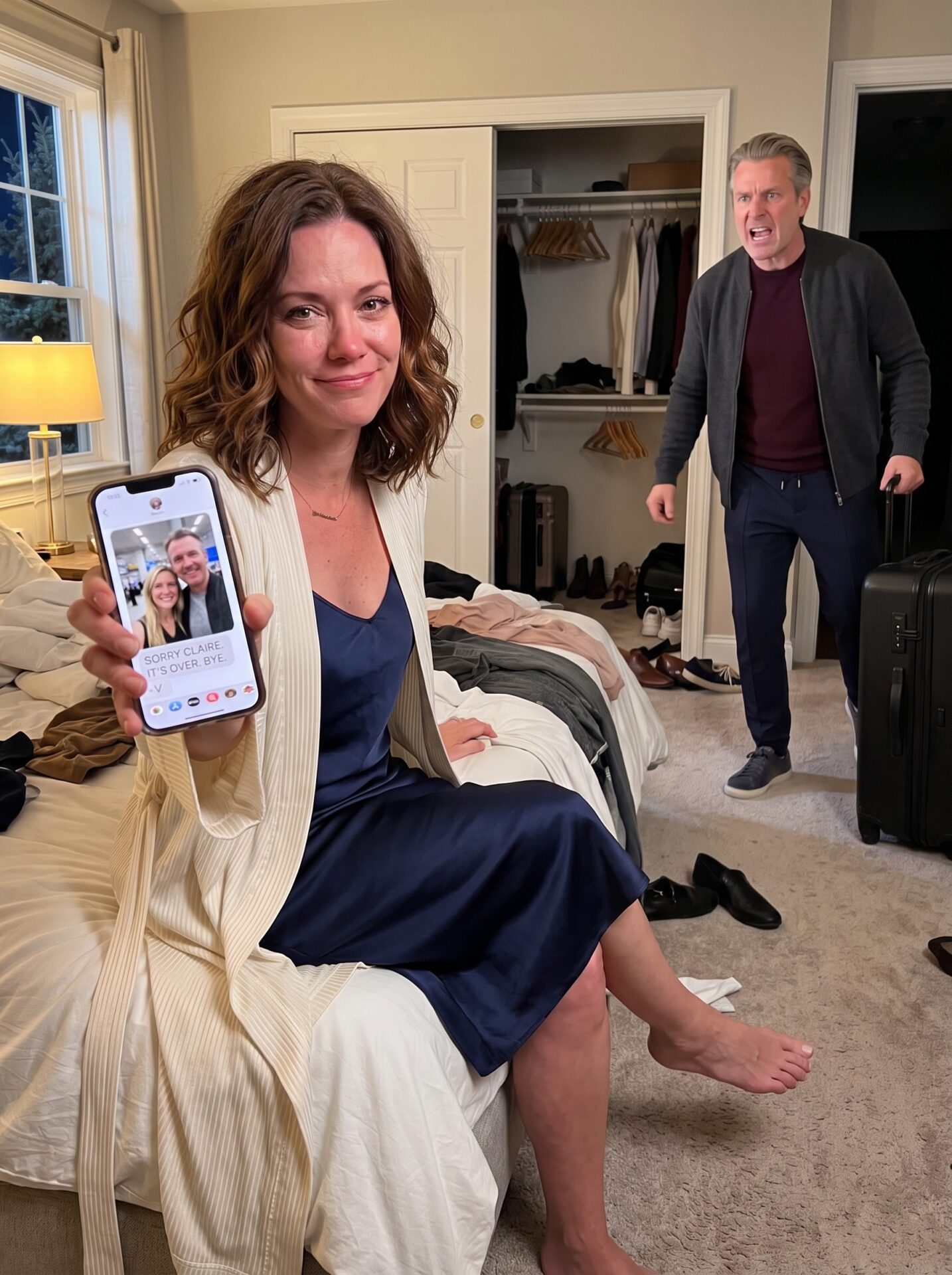
At 2 AM, my husband quietly packed his bags and crept out of our bedroom like a burglar. Half an hour later, he sent me a photo of himself with his mistress at the airport, grinning beneath the message, “Goodbye, useless woman! I’ve stripped you of all your assets!” I simply laughed.
At exactly 2:00 a.m., the sound of a suitcase zipper cut through the darkness like a blade leaving its sheath.
I remained motionless on my side of the bed, my eyes barely open, listening as my husband, Victor Langley, hurried carefully around our walk-in closet like a nervous thief. He believed the sleeping pills he had ground into my tea had taken effect.
They had not.
I had exchanged our cups.
For the next twenty minutes, I observed him in the reflection of the darkened window. Expensive shirts. His passport. Bundles of cash. The blue velvet case holding his cufflinks. He packed everything except his shame.
At 2:18 a.m., he approached the bed and looked down at me.
“Poor Claire,” he murmured. “You never even saw it coming.”
I kept my breaths deep and even.
He bent closer, bringing with him the scent of his costly cologne—the one his mistress had purchased for him, according to the receipt I had found inside his coat three weeks earlier.
Then he left.
I did not move until I heard his car disappear from the driveway.
My phone glowed at 2:37 a.m.
A photograph appeared.
Victor was standing inside Boston Logan Airport with Olivia Marsh, his twenty-nine-year-old mistress, wrapped against his chest. She had sunglasses on despite being indoors, and my diamond tennis bracelet circled her wrist.
Underneath the image was a message:
“Goodbye, useless woman! I’ve stripped you of all your assets!”
I read it.
Then I laughed.
Not because it caused no pain. It did. Eleven years of marriage can still wound you, even when you already know the blade is coming.
I laughed because Victor had always confused quietness with helplessness.
He assumed the house belonged to him because his name was printed on the mailbox. He believed the business accounts were his because I allowed him to occupy the largest chair during dinners with investors. He considered me useless because I always let him speak before I did.
What he did not realize was that six months earlier, after uncovering his affair, falsified signatures, secret debts, and the shell corporation registered under Olivia’s brother’s name, I had stopped acting like a wife and started gathering evidence.
Every financial statement. Every email exchange. Every hotel bill. Every intoxicated voice recording in which he boasted about “emptying Claire out before the divorce.” By 10:00 p.m. the night before, all of it had reached my lawyer, forensic accountant, and the FBI’s financial crimes division.
At 2:45 a.m., I sent a single response.
“Enjoy the airport.”
Victor called at 3:06 a.m.
I ignored it.
Olivia tried at 3:09.
Smiling, I emptied his drugged tea into the sink and watched December’s first snowfall cover the front yard.
By morning, Victor would discover that the passport he carried had become useless, the accounts he had raided were locked, and the woman he dismissed as worthless had already authorized the warrant that would bring him down.
Part 2
The first call arrived at 6:12 a.m. from Detective Marcus Reed.
“Mrs. Langley,” he said, his voice calm and professional, “your husband attempted to board Flight 418 to Zurich with Ms. Olivia Marsh. Homeland Security flagged both passports before boarding. They are currently being held for questioning.”
Wearing my robe, I stood in the kitchen and watched coffee fall slowly into the machine Victor had once declared “too cheap” for people of our status.
“Did he say anything?” I asked.
Detective Reed paused. In the background, I heard muted airport announcements, suitcase wheels, and travelers continuing toward lives that still belonged to them.
“He claimed you were emotionally unstable,” Detective Reed said. “Then he said you had given him full authority over all marital and business assets.”
I gave a quiet laugh. “Of course he did.”
“We also found one hundred and eighty thousand dollars in cash inside Ms. Marsh’s carry-on. Along with several certified checks made out from accounts linked to Langley Medical Logistics.”
Even then, the company’s name felt wrong in my mouth.
Langley Medical Logistics had begun inside my father’s Ohio garage, years before Victor understood anything about freight regulations. My father, Harold Whitaker, had developed partnerships with hospitals throughout the Midwest. I later expanded operations along the East Coast. Victor entered the business only after we married, bringing charisma, self-assurance, and almost no practical knowledge.
As the years passed, I allowed others to believe he was the company’s driving force. It simplified things. Investors responded to his grand speeches. Clients trusted my quiet competence. Privately, I repaired his calculations, corrected his failures, and rescued contracts he nearly destroyed.
Then Olivia entered the picture.
Her beauty was not the real problem. Her ambition was wild and careless. She repeatedly told Victor he deserved more. To her, I was plain and dull, “a spreadsheet in human form.” I had seen the phrase in one of their conversations.
But spreadsheets retain every detail.
At 8:00 a.m., my attorney, Diane Caldwell, came to the house with two associates and a closed folder.
“You look rested,” she said, pulling off her gloves.
“I slept before the storm.”
Diane smiled. “Good. Because Victor’s attorney is already demanding an emergency hearing. He claims you froze the accounts out of revenge.”
I accepted the folder. “Can he prove legal access?”
“No. That is the beautiful part. The company restructuring you approved last month placed operational control under the Whitaker Family Trust. Victor signed it himself.”
“He thought it was tax planning,” I said.
“He never read page seven.”
Victor rarely read anything longer than a restaurant menu.
By midday, our board members had heard about the situation. Three contacted me privately. One offered an apology. Another acted as though he had suspected Victor’s instability for years. Arthur Bell, the third, wanted to know whether quarterly deliveries would suffer.
“No,” I told him. “The company will run better by Monday.”
At 2:30 p.m., I listened to Victor’s first recorded message.
“Claire, listen to me. This is a misunderstanding. Olivia panicked. I didn’t mean that message. You know how I get when I’m angry. Call Diane off. We can fix this.”
His second voicemail was more aggressive.
“You think you’re clever? You think paperwork makes you powerful? I made you relevant!”
Olivia left the third.
“Claire, please. Victor told me you two were separated. I didn’t know about the money. I didn’t know any of this was illegal.”
I played it a second time.
Not because I trusted her explanation.
I listened because the trembling in her voice sounded exactly like mine had five months earlier, when I stood alone in the bathroom reading her messages on Victor’s phone and understood that my marriage had not shattered in one dramatic moment. It had been quietly taken apart while I struggled to preserve the life we had built.
That evening, Diane and I faced Victor across a conference table inside the federal building.
Without his custom-tailored coat, he seemed diminished.
His gaze fixed on me. “Claire,” he said, softening his voice, “baby, please.”
I placed my hands together on the table.
“You called me useless at 2:37 this morning.”
Beside her public defender, Olivia lowered her eyes.
Victor swallowed hard. “I was angry.”
“No,” I said. “You were honest. That was your mistake.”
Diane unsealed the folder and pushed a document toward him.
The color vanished from Victor’s face as he read the opening page.
It was not a petition for divorce.
It was a civil action accusing him of fraud, violation of fiduciary obligations, conversion of corporate money, identity theft, and conspiracy.
I rose from my chair.
“Enjoy the hearing, Victor.”
His hands tightened around the table’s edge. “Claire, you can’t destroy me.”
I studied the man I had once loved, the man who had interpreted my patience as permanent permission.
“I’m not destroying you,” I said. “I’m returning everything you built.”
PART 3
Two days later, the emergency hearing was held at Suffolk County Superior Court.
Victor entered wearing a navy suit that had been poorly pressed. I took more satisfaction in that than I should have. For years, I had managed all the unseen details that created his polished appearance: the dry cleaning, restaurant bookings, charity lists, presents for clients’ spouses, revised speeches, and carefully worded apologies. Without my help, he resembled a man who had thrown on clothes in a rush and mistaken it for a plan.
Olivia sat in the row behind him, without jewelry. My diamond bracelet had already been photographed, entered into evidence, and delivered to Diane’s office for protection.
Judge Evelyn Ross entered at 9:05 a.m. and immediately made it clear she had little tolerance for delays.
Victor’s lawyer, a sharp-featured attorney named Peter Nolan, rose first.
“Your Honor, my client has been locked out of personal and professional accounts by his wife in an act of emotional retaliation. Mr. Langley has been a senior executive of Langley Medical Logistics for nearly eight years. He has a right to access funds necessary for his living expenses and legal defense.”
Judge Ross peered over the top of her glasses. “Was Mr. Langley attempting international travel when these accounts were frozen?”
Nolan paused. “He had planned a short business trip.”
Diane stood with deliberate calm. “With his mistress, Your Honor. One-way tickets to Zurich. Purchased under aliases. Carrying one hundred and eighty thousand dollars in cash and certified checks drawn from company accounts he was not authorized to access.”
A subtle movement passed through the courtroom. Even the court clerk raised his head.
Nolan’s jaw hardened. “Those allegations are under investigation.”
“They are documented,” Diane replied.
She displayed the first piece of evidence on the screen.
One transfer record.
Then another.
Then a series of emails exchanged by Victor and Olivia’s brother, Grant Marsh, explaining how money should be moved through a consulting firm with no staff, no physical location, and no genuine clients.
Victor kept his eyes fixed ahead.
I focused on his hands. His right thumb repeatedly brushed his wedding band, which remained on his finger. Perhaps he believed it made him appear more sympathetic. Perhaps habit had outlasted his guilt.
Diane then projected the airport message he had sent me.
“Goodbye, useless woman! I’ve stripped you of all your assets!”
The sentence appeared in stark black lettering across the screen.
Sometimes a room suddenly feels colder even though the temperature has not changed. This was one of those moments.
Judge Ross examined the message two times.
“Mr. Nolan,” she said, “does your client dispute sending this?”
Nolan turned toward Victor.
Victor stared down at the table.
“No, Your Honor,” Nolan said.
Diane went on. “Mrs. Langley did not freeze accounts in retaliation. The Whitaker Family Trust, majority owner of Langley Medical Logistics, initiated emergency protective action after forensic accountants identified unauthorized transfers totaling 2.6 million dollars over a period of nine months.”
Victor’s head snapped in my direction.
It was the first time he had been told the full amount.
He had assumed he was taking money in portions small enough to escape detection. A fabricated consulting expense here. A payment to a false supplier there. A so-called “temporary liquidity adjustment” concealed inside a quarterly filing.
But spreadsheets retain everything.
Diane continued evenly. “Mr. Langley also executed documents last month acknowledging the trust’s final operational authority in cases involving executive misconduct. His signature appears on pages seven, twelve, and nineteen.”
Judge Ross turned to him. “Mr. Langley, did you read what you signed?”
Victor’s cheeks flushed. “Claire handled documents. She always put things in front of me and said they were routine.”
I nearly smiled.
That was his complete defense: he had relied on the useless woman to manage every important detail.
Judge Ross remained unmoved.
“Your signature is not decorative, Mr. Langley.”
When the hearing ended, Victor remained barred from every corporate account. The judge issued a temporary restraining order forbidding him from selling, concealing, transferring, or taking loans against marital property. His passport remained with federal officials. Olivia was instructed to provide all financial information and communications connected to Grant Marsh’s business.
After the judge left, Victor pushed his chair backward.
“Claire,” he snapped.
Diane placed a hand against my sleeve, but I gave a slight shake of my head. I wanted to hear the last scene he intended to perform.
He came close enough that I could see the dark exhaustion beneath his eyes.
“You planned this,” he whispered.
“Yes.”
My admission seemed to hurt him more than any denial could have.
“For how long?”
“Long enough.”
His expression tightened. “You set me up.”
“No, Victor. I documented you.”
He moved nearer. “You think you’ll keep the company? You think the board wants you? They liked me. They respected me.”
“They tolerated you because I made you useful.”
For the first time during our eleven-year marriage, Victor had no instant response.
I turned away before he could produce one.
The following weeks were harsh, but they were not disorderly. Preparation had given me that advantage.
Grant Marsh attempted to erase corporate records from a rented workspace in Providence. The FBI already possessed duplicate copies obtained through a subpoena for the company’s cloud storage. Olivia initially maintained that she knew nothing. Later, she admitted helping Victor create accounts after he promised they would “start fresh in Europe.” Cooperating reduced the consequences she faced, but it did not remove them.
Victor challenged every development.
He contested the divorce.
He opposed the civil lawsuit.
He fought the board’s decision to dismiss him.
He even resisted returning my mother’s emerald earrings, arguing that they had been “gifted to the marital household,” although photographs from my university graduation showed them around my neck years before I knew him.
Each new lie produced another record.
Each new record made Diane grin.
The board gathered on January 14th in the conference room on the highest floor of our Boston headquarters. Snow moved past the windows, blurring the harbor into a sheet of gray. Twelve directors surrounded the long walnut table. Several had known my father personally. Others had invested after Victor became involved. Every face appeared guarded.
Arthur Bell cleared his throat. “Claire, no one questions your competence.”
Statements like that usually introduce the exact opposite.
I said nothing.
He went on, “But the public nature of this scandal could affect hospital confidence. We need stability.”
“Agreed,” I said.
Priya Desai, one of the younger directors, leaned over the table. “What are you proposing?”
I opened the documents before me.
“First, immediate rebranding. The company will return to its original name: Whitaker Medical Logistics. Second, an independent audit of all vendor relationships. Third, a client communication plan already drafted and ready for distribution. Fourth, Victor’s executive role is terminated for cause, effective immediately, with all compensation suspended pending litigation.”
Arthur narrowed his eyes. “You prepared all this?”
“Yes.”
“Before today?”
“Before Victor reached the airport.”
No one spoke.
Then Priya smiled.
“I vote yes.”
The proposal passed with nine votes in favor and three against.
That same afternoon, I was appointed acting CEO.
Not because I was the betrayed wife of Victor Langley.
Because my hands had always been the ones operating the company.
Our initial public announcement was released at 4:00 p.m. It was restrained, factual, and deliberately dull, exactly as responsible crisis communication should be. No public accusations. No emotional language. No references to affairs or photographs sent from airports. Only corporate oversight, uninterrupted service, and dedication to patient care.
Hospitals had no interest in Victor’s wounded pride. They wanted insulin delivered when promised, surgical materials processed according to regulations, and temperature-controlled medicine protected throughout transportation.
They remained with us.
By March, we had secured agreements with two additional hospital networks.
The forensic investigation ended in May.
In June, Victor agreed to plead guilty to financial offenses involving unauthorized transactions and falsified documentation. The punishment lacked cinematic drama. Real consequences usually do. No one collapsed. There was no thunder outside. No hysterical confession echoed through the courtroom.
Victor stood rigidly before the judge, his face drained of color, while each condition was read aloud.
Restitution.
Terms of probation.
A suspended prison sentence dependent on his cooperation and repayment.
A permanent prohibition against holding executive authority over fiduciary funds.
The civil proceedings stripped away almost everything he had attempted to take.
Our divorce became final in September.
I received the house, but placed it on the market three months later. I had no desire to remain in rooms where I had spent years pretending not to see the distance widening between us. My new home was more modest, filled with broad windows and bare, fresh walls. No old memories waited in its closets.
Victor rented a condominium near Hartford. Olivia moved away from Boston. The last information I heard was that she had returned to real estate and resumed using her maiden name. I had no interest in tracking either of them. Real freedom means no longer checking whether the people who harmed you are suffering.
Exactly one year after Victor sent the airport photograph, I attended a medical logistics convention in Chicago. Whitaker Medical Logistics had received a regional excellence award. My father, moving more slowly now with age, watched from the front table with tears filling his eyes as I stepped forward to accept it.
Following dinner, while attendees crowded around the bar, my phone vibrated.
The number was unfamiliar.
For a moment, I considered leaving it unopened.
Then I read the message.
It came from Victor.
“Claire. I know I don’t deserve a response. I just wanted to say I understand now. You were never useless. I was.”
I looked at the message for a long time.
It brought no real pleasure. At least, not the satisfaction people often imagine. Revenge burns brightly only in stories. In reality, when the person who wounded you finally recognizes what they did, you have usually traveled too far beneath that burden to celebrate.
My father approached and stopped beside me.
“Everything all right?” he asked.
I turned off the phone.
“Yes,” I said. “Just an old account closing.”
He nodded as though my answer required no further explanation.
Later, I went back to my hotel room, which overlooked the Chicago River. Reflections from the city stretched across the water like shattered threads of gold. I removed my shoes, placed the award on the desk, and prepared a cup of tea.
No medication hidden inside.
No performance.
No movement through the darkness.
I remembered the version of myself from 2:00 a.m. the previous year, lying silently while her husband packed to begin another life with someone else. She had been frightened, furious, and deeply wounded, but she had also prepared herself.
That had made all the difference.
People commonly believe betrayal begins when someone finally walks away.
It begins long before that moment.
With the first password kept secret.
The first charge that cannot be explained.
The first joke intended to reduce you.
The first time you swallow your own words to maintain peace with someone who is already preparing for war.
Victor did not lose because I acted without mercy. He lost because he assumed loving him had made me unable to see. He believed patience meant I knew nothing. He believed quiet women failed to preserve evidence.
At 11:58 p.m., I wrote a response.
Not because I wanted the door reopened.
Not because I wished to forgive him simply to relieve his conscience.
I answered only to complete the farewell he had begun at the airport.
“You were right about one thing, Victor. Goodbye.”
I blocked his number.
Then I slept more peacefully than I had in years.