
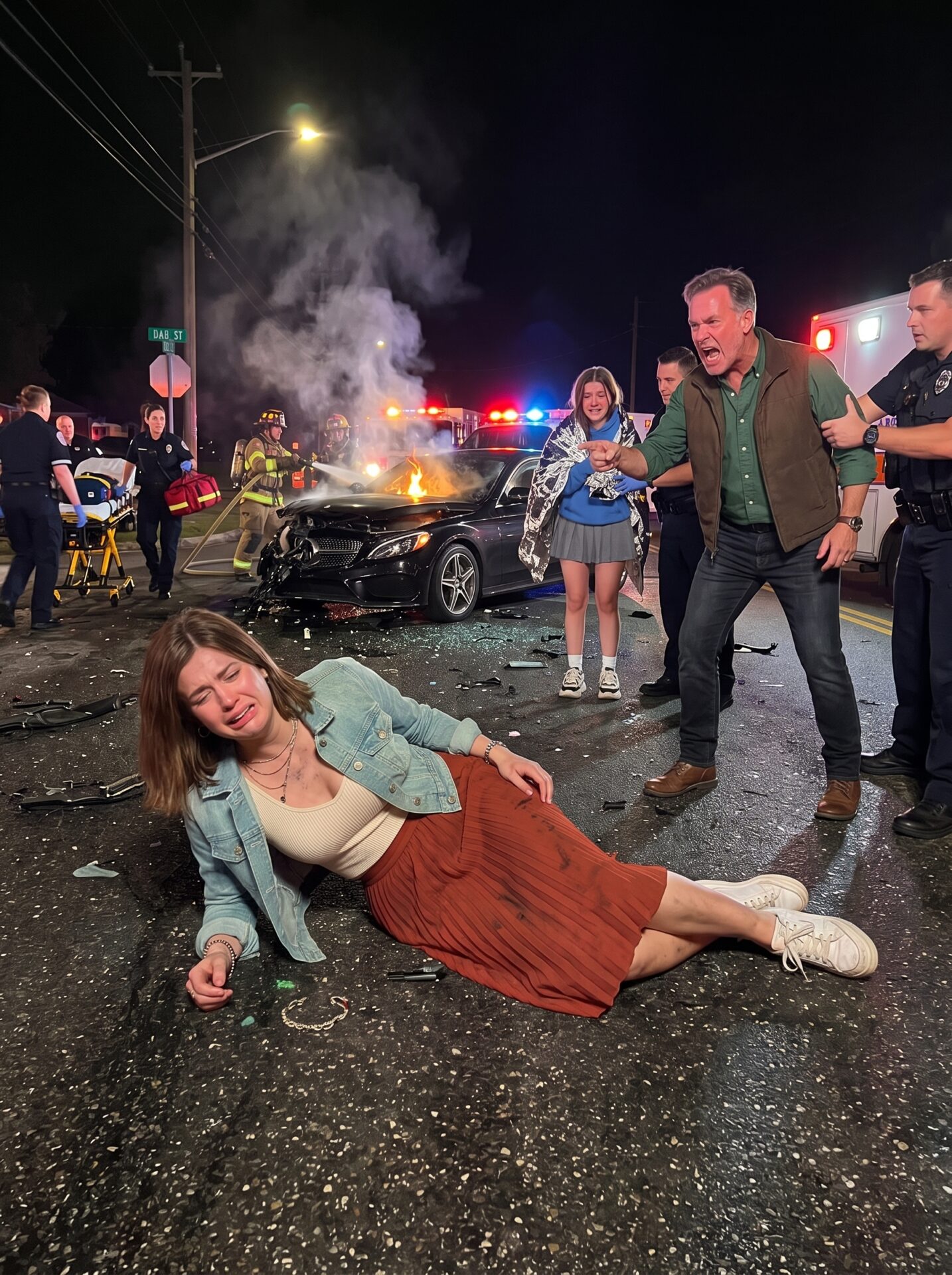
After our car crash, I was still stuck inside when my father yelled at the paramedics to save my sister first. Then he pointed toward me and said, “The other one never meant much anyway. Don’t waste time on her.” I was still awake, and I heard every single word.
After our car accident, my father told the paramedics, “Save my daughter first — the other one never meant much anyway. Don’t waste time on her!”
I heard every word.
I was trapped on the passenger side of my father’s black Lincoln, my left leg crushed beneath the bent door while firefighters tried to cut their way to me. Smoke drifted through the night as red and blue emergency lights flashed across Riverside Drive, turning everything into a blur of color and sirens.
My younger sister, Olivia, sat a few feet away wrapped in a silver emergency blanket, crying out for Dad. She had a cut across her forehead and a broken wrist. I could see her moving. I could hear her sob.
I could not feel my feet.
“Sir, step back,” one paramedic snapped.
“My Olivia first!” Dad shouted. His voice cracked, but not because he was worried about me. “She’s all I have. Grace is—” He stopped, then said it anyway. “Grace is not important.”
The firefighter nearest me paused briefly. His eyes met mine through the smoke.
I wanted to tell him that I mattered.
I wanted to tell my father that I had packed Olivia’s lunch every school morning since Mom died, that I had worked double shifts at the diner to help cover the bills he forgot, that I had given up Boston University for community college because he said the family needed me.
But I could barely speak.
Everything had changed only minutes before.
Dad had picked us up from Aunt Meredith’s house. Olivia wanted to stop for coffee. Dad said no. I noticed a strange smell in the car, but when I mentioned it, Dad told me to stop being dramatic.
Moments later, the engine sputtered.
Then everything went black.
A paramedic knelt beside me.
“Grace, can you hear me?”
I blinked once.
“We’re getting you out.”
Behind him, Dad held Olivia’s hand and kissed her knuckles.
“You’re safe, sweetheart. I’m here.”
Olivia looked past him at me.
For one brief second, her face changed.
Not fear.
Not sadness.
Guilt.
That was when I remembered what she had whispered before Dad started the car.
“Grace, don’t be mad. I only told him because I thought he already knew.”
Told him what?
The answer slowly returned.
The bank envelope in my backpack.
The acceptance letter.
The apartment deposit.
My plan to leave both of them.
The firefighters finally pulled me out.
Dad never even looked toward me.
That night, I stopped being his unwanted daughter.
I became his witness.
Part 2
I woke up three days later at St. Vincent Medical Center with tubes in my arms, stitches across my ribs, and a police officer sitting outside my hospital room.
At first, I thought he was there because of the crash.
Then Aunt Meredith leaned over my bed and whispered, “Grace, honey, don’t talk to your father alone.”
Her face was pale. She looked older than she had on Sunday. Her silver hair was tied back messily, and she held my hand as if she feared I might vanish if she let go.
“What happened?” I asked. My voice sounded rough and dry.
“You were badly hurt,” she said.
“I know that.”
Her eyes shifted toward the door. “The police found something.”
Before she could explain, Dad walked in carrying flowers from the hospital gift shop. Cheap daisies. The kind he used to buy Mom when he had forgotten an anniversary.
“Gracie,” he said softly.
I stared at him.
He tried to smile, but it trembled. “You scared us.”
Us.
The word almost made me laugh.
Aunt Meredith stood. “Daniel, the doctor said she needs rest.”
“I’m her father.”
“And I’m the person she asked for when she woke up.”
Dad’s face tightened. For one second, the mask slipped, just long enough for me to see the same coldness I had heard on the road.
Then he became gentle again.
“Grace,” he said, stepping closer, “you may have heard things that night that sounded wrong. I was panicking. Olivia was bleeding. I didn’t know what I was saying.”
I remembered every syllable.
“The other one never meant much anyway.”
My fingers curled against the blanket.
“I heard you,” I said.
His eyes sharpened.
Aunt Meredith moved beside my bed.
Dad lowered his voice. “You were confused. You had a concussion.”
“No,” I said. “I was awake.”
He glanced at the officer outside the door, then back at me. “This is family business.”
That was when Detective Maria Keller entered.
She was in her forties, composed, with dark hair pulled into a low bun and a notebook in her hand. She did not introduce herself like someone asking permission. She introduced herself like someone gathering facts.
“Grace Holloway,” she said, “I’m Detective Keller. When you feel ready, I need to ask you about the vehicle.”
Dad gave a short laugh. “My daughter just woke up.”
Detective Keller did not look at him. “Mr. Holloway, you can wait outside.”
“I’m not leaving.”
“Yes,” she said. “You are.”
The officer appeared in the doorway.
Dad’s mouth tightened again, but he left.
Detective Keller closed the door.
Then she said, “The explosion was not an accident.”
My heart monitor started beeping faster.
She opened her notebook. “Someone tampered with the fuel line. There was also evidence of an accelerant under the driver’s side. But here’s what doesn’t make sense. Your father had the car serviced two days earlier, and the mechanic says he warned him not to drive it until a full inspection was completed.”
Aunt Meredith covered her mouth.
I stared up at the ceiling.
Dad had known something was wrong.
Detective Keller continued. “Your sister says she doesn’t remember anything before the explosion.”
“She remembers,” I whispered.
Both women looked at me.
“She told him something,” I said. “Before we got in the car. She said, ‘Don’t be mad. I only told him because I thought he already knew.’”
“What did she mean?” Keller asked.
“My bank account. My apartment deposit. My college transfer.”
Aunt Meredith closed her eyes.
I swallowed through the pain. “I was leaving.”
Detective Keller’s expression changed, not dramatically, but enough.
“Grace,” she asked, “did your father benefit from you staying?”
I thought about the bills in my name. The diner paychecks he borrowed and never paid back. The life insurance policy Mom had left, controlled by Dad until I turned twenty-one in six months.
Then I thought about the explosion.
“Yes,” I said. “He did.”
PART 3
Detective Keller did not reveal everything to me that day. She only asked enough questions to know where she needed to look next.
Over the next week, while doctors changed my bandages and physical therapists taught me how to stand without collapsing, the truth arrived in fragments.
First came the mechanic.
His name was Peter Walsh, owner of Walsh Auto Repair in Newark, New Jersey. He told police that Dad had brought in the Lincoln after complaining about “a strange smell” and “rough starting.” Peter found a cracked fuel line and warned him the car was unsafe.
“I told Daniel not to drive it,” Peter said in his recorded statement. “I even wrote it on the invoice. Vehicle unsafe. Tow recommended.”
Dad had signed the invoice.
Then he drove the car anyway.
Second came the insurance.
Mom had left behind a structured settlement from a workplace accident years before. I had not known the details because Dad always said, “Your mother trusted me to handle it.”
That was a lie.
Mom had placed half of the remaining money into a protected account for me. It would be released when I turned twenty-one. Until then, Dad could request funds only for my education, medical care, or housing.
According to the records Detective Keller uncovered, he had tried three times in the past year to access the money.
All three requests had been rejected.
Third came Olivia.
At first, she avoided my room. Aunt Meredith said she was “traumatized,” but I knew my sister better than that. Olivia had never handled consequences well. She was sixteen, pretty, anxious, and used to being rescued from every mistake by our father’s gentle voice and my tired hands.
When she finally came to see me, she stood in the doorway with her wrist in a cast and her hair perfectly braided.
“Grace,” she said.
I did not respond.
She looked at the machines, the bruises on my arms, the brace around my leg. Tears filled her eyes.
“I didn’t know this would happen.”
That was the first honest thing she said.
Aunt Meredith stood from the chair beside me. “I’ll get coffee.”
After she left, Olivia came closer, but not too close.
“What did you tell him?” I asked.
Her lower lip trembled. “He found your Boston University folder.”
“No. You told him something before we got in the car.”
She looked down.
“What did you tell him, Olivia?”
Her voice became small. “That you had an apartment.”
My chest tightened, but I waited.
“And?” I asked.
“And that you were moving the week after graduation.”
I closed my eyes.
Dad had not exploded because I was leaving emotionally. He had exploded because I was leaving financially.
The bills. The settlement. The control. The free childcare. The daughter he did not love but still needed.
“He got quiet,” Olivia whispered. “Not angry at first. Just quiet. Then he asked where the paperwork was. I told him your backpack. I thought he was going to yell at you. That’s all.”
“You thought he was going to stop me.”
She nodded, crying now.
“You wanted him to stop me.”
She did not deny it.
The silence between us felt older than either of us.
I had raised Olivia after Mom died. I had taught her how to curl her hair, helped her study biology, driven her to sleepovers, protected her from Dad’s drinking, and made excuses when he forgot her birthdays. But love without boundaries had turned into something else. She had learned that my life was a resource.
Not a life.
“Grace,” she said, “I’m sorry.”
I looked at her bandaged wrist.
“Did you hear what he said after the explosion?”
Her crying stopped.
Then I knew she had.
She stared at the floor.
“He said to save you first,” I said. “And not to waste time on me.”
“He was scared.”
“No,” I said. “He was honest.”
Olivia wiped her face with her sleeve like a child.
I wanted to hate her. Part of me did. But another part of me saw exactly what Dad had created: one daughter trained to sacrifice, the other trained to receive. Neither of us had left that house intact.
Still, damage explained something. It did not erase it.
“When Detective Keller asks you what happened,” I said, “tell the truth.”
Olivia immediately shook her head. “Dad said if I talk, they’ll blame me.”
“Did you damage the car?”
“No!”
“Did you light anything?”
“No.”
“Then tell the truth.”
She stepped back. “You don’t understand. He’s all I have.”
I laughed then, a dry, painful sound that pulled at my stitches.
“No, Olivia. He’s all you chose.”
She left without hugging me.
Two days later, Detective Keller returned with a folder.
“Your sister made a statement,” she said.
I expected disappointment. I expected fear.
Instead, Keller opened the folder and placed a transcript on my blanket.
Olivia had told them everything.
She told them Dad had found my transfer acceptance letter. She told them he searched my backpack while I was in Aunt Meredith’s kitchen. She told them he took the bank envelope and sat alone in the car for nearly twenty minutes before calling us outside.
Most importantly, she told them what Dad said when she asked why the car smelled worse than before.Used
“Don’t worry,” he told her. “Grace always makes problems sound bigger than they are.”
That sentence did not prove murder.
But it proved knowledge.
The arrest happened on a rainy Thursday morning.
I watched it on the local news from my hospital bed. Daniel Holloway, fifty-two, was led out of our split-level house in handcuffs while reporters stood beneath umbrellas at the curb. He did not look afraid. He looked insulted.
The headline read: Newark Father Arrested After Car Explosion Injures Two Daughters.
Aunt Meredith muted the television.
“You don’t have to watch,” she said.
“Yes,” I said. “I do.”
At the first hearing, Dad’s attorney argued that the explosion had been a tragic accident and that my father had been “emotionally overwhelmed” when he spoke to the paramedics.
Detective Keller testified about the mechanic’s warning.
Peter Walsh testified about the signed invoice.
The fire investigator testified that the damage to the fuel line was consistent with deliberate tampering after the mechanic had inspected it.
Then the prosecutor played audio from a firefighter’s body camera.
The courtroom heard Dad’s voice clearly.
“Save my daughter first — the other one never meant much anyway. Don’t waste time on her!”
I sat in the front row beside Aunt Meredith, my cane resting across my knees.
Dad did not look at me while the recording played. He looked at the judge, as if expecting someone important to understand that I had always been inconvenient.
Olivia sat three rows behind me. She cried silently through most of the hearing.
When I was called to testify months later, my leg had healed enough for me to walk slowly. The scars remained, thick and pale along my thigh and ribs. My voice shook only once: when the prosecutor asked what I remembered after the explosion.
“I remember believing I was going to die,” I said. “And I remember my father deciding that was acceptable.”
The defense attorney tried to make me sound resentful.
“Ms. Holloway,” he said, “isn’t it true you planned to leave your family?”
“Yes.”
“Isn’t it true you hid money from your father?”
“Yes.”
“Isn’t it true there was tension in the household?”
I looked at the jury.
“There is always tension when one person is trying to escape and another person is trying to keep ownership of them.”
The courtroom became very quiet.
Dad was convicted of attempted murder, reckless endangerment, insurance fraud, and financial exploitation. The judge sentenced him to twenty-eight years in prison.
He shouted when the sentence was read.
Not that he was innocent.
Not that he loved us.
He shouted, “After everything I gave you!”
That was the last thing I ever heard him say in person.
Recovery moved more slowly than justice.
In stories, people leave the courtroom and are instantly free. In real life, freedom limps. It fills out medical forms. It wakes at three in the morning from dreams of fire. It learns that surviving is not the same as healing.
I stayed with Aunt Meredith for six months. Her house in Montclair smelled like lemon cleaner and old books. She did not ask me to forgive anyone. She did not tell me family was complicated. She simply put clean sheets on the guest bed and said, “You can stay as long as you need.”
I began physical therapy three times a week. I returned to classes online. Boston University deferred my transfer for one semester after Aunt Meredith called and explained what had happened. My protected account was finally placed under court supervision until my birthday, beyond Dad’s reach.
Olivia went to counseling because the court first required it. Then, surprisingly, she continued.
For a long time, I did not speak to her.
She sent letters. I did not open the first four.
The fifth arrived on my twenty-first birthday. It came in a plain white envelope, my name written carefully in blue ink.
I opened it at Aunt Meredith’s kitchen table.
Grace,
I used to think love meant someone would always choose me first. Dad taught me that. You paid the price for it.
I told him about your apartment because I was scared you would leave and I would have to live with him alone. That was selfish. I know saying sorry does not fix your leg or your scars or what you heard that night.
I am not asking you to forgive me.
I just want you to know I told the truth because you deserved at least one person in that family to finally do that.
Olivia
I read it twice.
Then I folded it and returned it to the envelope.
Aunt Meredith watched me from the stove. “Are you okay?”
“No,” I said. “But I’m better than I was.”
That summer, I moved to Boston.
My apartment was small, expensive, and perfect. The radiator clanked. The upstairs neighbor played jazz too loudly. The kitchen had one drawer that would not close unless I kicked it. I loved every inch of it because no one in that apartment needed me to disappear so they could be comfortable.
On my first night there, I sat on the floor because my furniture had not arrived yet. I ate takeout noodles from a cardboard container and watched headlights move across the ceiling.
For the first time since Mom died, silence did not feel dangerous.
It felt like mine.
A year later, Olivia came to visit.
She was eighteen by then, thinner and quieter, with less polish and more truth in her face. We met at a café near campus because I was not ready to let her into my home.
She sat across from me holding a paper cup in both hands.
“I got into Rutgers,” she said.
“That’s good.”
“I’m paying for part of it myself.”
“That’s also good.”
She nodded. “I’m trying not to be helpless anymore.”
I looked out the window at students crossing the street with backpacks and iced coffees and ordinary problems.
“I don’t know what we are,” I said.
Olivia swallowed. “Sisters?”
“Not the way we were.”
“No,” she said. “Not that way.”
That was the beginning. Not a reunion. Not a clean ending. Just a beginning with rules.
We talked once a month. Then twice. Sometimes we argued. Sometimes we sat silently on the phone. She learned not to ask me to save her. I learned that boundaries did not make me cruel.
Three years after the explosion, Detective Keller called me.
“I wanted you to hear it from me,” she said. “Your father’s appeal was denied.”
I was standing outside the university library, holding a stack of casebooks against my chest. After everything, I had changed my major to social work, then added legal studies because I wanted to understand the systems that had almost failed me and the people who had not.
“Thank you,” I said.
There was a pause.
“You built a life, Grace,” Keller said.
I looked at my reflection in the library glass. My scars were hidden beneath my jeans and sweater, but I knew exactly where they were.
“Yes,” I said. “I did.”
That night, I walked beside the Charles River. The water looked black beneath the city lights. Cars passed behind me, tires whispering across the bridge. For one second, the smell of exhaust tightened my throat.
I stopped walking.
I breathed in.
I breathed out.
The memory came back, sharp as broken glass: fire, metal, Dad’s voice, Olivia crying, the paramedic leaning over me.
“Grace, can you hear me?”
Yes.
I could hear then.
I could hear now.
But my father’s sentence no longer defined the story.
The other one never meant much anyway.
He had spoken it like a verdict.
He had been wrong.
I mattered enough to survive him.
I mattered enough to testify.
I mattered enough to leave.
And on a cold Boston night, with the river moving beside me and my future finally belonging to me, I understood something simple and permanent:
I had never been the other one.
I had always been Grace.