
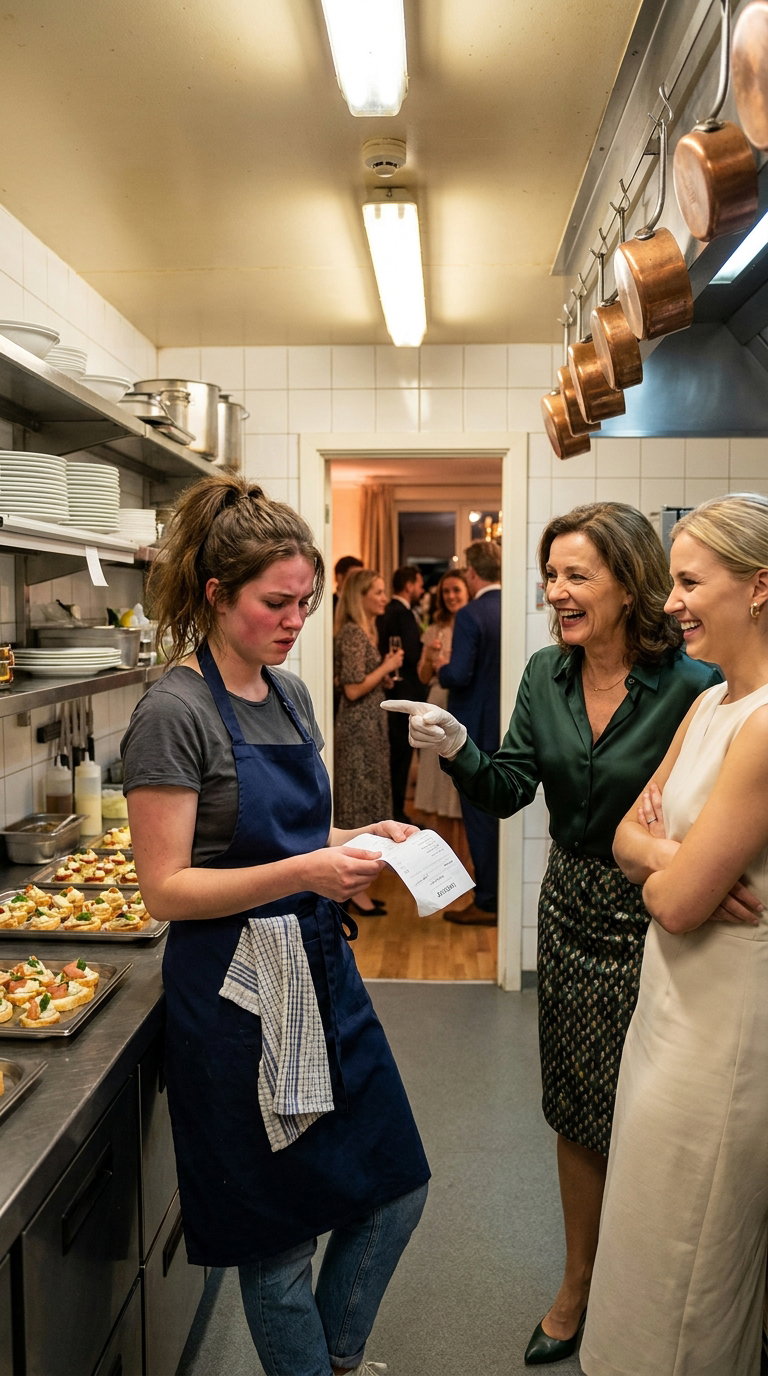
Mom tossed a list at me like it was a prison sentence. “Cook for thirty people. Clean before and after. Your sister’s engagement party needs to be perfect.”
The paper struck my chest before sliding onto the kitchen counter.
I picked it up slowly.
Appetizers. Main courses. Dessert station. Flowers. Guest bathroom. Patio lighting. Champagne glasses. Trash cleanup. Coffee setup. Emergency sewing kit. Gift table. Mop floors before guests arrive. Mop floors after guests leave.
My name was written beside every single task.
Not guest.
Not sister of the bride.
Labor.
I read the list twice.
Then I looked at my mother and asked, “Where exactly do I sit?”
She laughed.
Not cruelly at first.
Automatically.
Like the question itself sounded absurd.
“You don’t,” she replied. “You’ll be running in and out of the kitchen. Stop making everything about yourself.”
My sister Marissa stood beside the refrigerator admiring her engagement ring beneath the light.
“It’s not personal,” she said casually. “You’re just better at service things.”
Service things.
That was apparently what they called twenty years of saving them from their own irresponsibility.
I organized Dad’s retirement party because Mom “couldn’t deal with vendors.” I planned Marissa’s baby shower for a baby she didn’t even have yet because she wanted photos before starting fertility treatments. I cooked Thanksgiving dinners after twelve-hour shifts. I bought birthday cakes and let everyone else sign the cards. I covered deposits whenever Mom forgot. I picked relatives up from airports. I smiled quietly in the background of family photos that were later cropped.
But this felt different.
This was my sister’s engagement party, hosted inside the same house I helped Mom keep after Dad died.
She either forgot that.
Or chose not to remember because it benefited her.
For four years, I quietly paid the property taxes, overdue utilities, and insurance because Mom cried about losing “the only home we had left.” I paid for the broken furnace repairs. I funded the patio renovation Marissa now planned to decorate with champagne towers.
I never asked anyone to praise me.
But stupidly, I hoped for a chair.
Marissa took the list from my hand and added another line.
Wear black. Something plain.
“Why?” I asked.
“So nobody confuses you with the party,” she answered with a smile.
Mom nodded approvingly. “By six o’clock, everything should already be ready. Then just stay available.”
I folded the list carefully.
Smiled.
“Of course,” I said softly.
By 9 p.m. on the night of the party, I was gone.
And when they arrived to find a dark, empty house, my phone already showed forty-seven missed calls.
Part 2
I ignored the first call.
And the tenth.
And the thirtieth.
I sat alone in a hotel room across town wearing the green dress I originally bought for the engagement party before learning I wasn’t important enough to sit down at it. My hair was curled. My makeup was done. Beside me on the desk sat the folded list and a glass of untouched wine.
My phone lit up again.
Mom.
Then Marissa.
Then Mom again.
Then Marissa’s fiancé.
Then Aunt Carol.
At first, the messages sounded polite.
Where are you?
Guests are arriving.
Did you pick up the food?
The house is locked.
The lights aren’t working.
Why is the caterer asking for payment?
Then eventually they became honest.
You’re ruining your sister’s engagement.
Stop acting selfish.
Open the house.
People are standing outside.
I smiled quietly.
Because the house was locked intentionally.
At 5 p.m., I called the security company and removed every temporary access code connected to the party. At 5:15, I canceled the catering order Mom placed using my name. At 5:30, I canceled the florist because my card was the only payment method on file. At 5:45, I informed the rental company not to deliver tables, chairs, linens, or champagne glasses unless the actual hosts paid first.
Nobody paid.
Because everyone assumed I would.
At 6:02, guests started arriving at a dark house with no music, no food, no unlocked doors, and no sister left behind to rescue everything.
At 7:18, Mom left a voicemail so loud the audio distorted.
“You owe us an explanation!”
I looked down at the folded list.
Then I sent one message into the family group chat.
I was told I didn’t have a seat. So I stopped setting the table.
For five full minutes, nobody replied.
Then Marissa called fifteen times in a row.
At 9:04, Mom sent a photo.
Thirty confused guests standing in the driveway while Marissa cried beside a half-finished balloon arch.
Underneath the picture, Mom typed:
How could you do this?
I replied:
I learned from you. It’s not personal.
Part 3
The next morning, Mom appeared outside my hotel room.
I never told her where I stayed.
That meant Marissa’s fiancé did. He was the only person practical enough to check the emergency contact sheet I created.
Mom looked smaller without an audience watching.
“You humiliated your sister,” she said immediately.
I only opened the door halfway.
“No,” I answered calmly. “I let her host her own party.”
“She was crying in front of everyone.”
“I cried alone in kitchens for years. Nobody came looking for me.”
Her face tightened instantly. “This is seriously all about a chair?”
I almost laughed.
“It was never about the chair.”
Then I opened the folder sitting on the dresser and handed her copies of every payment tied to the house.
Taxes.
Utilities.
Insurance.
Roof repairs.
Plumbing bills.
Electrical work.
Patio renovation.
Four years of emergencies that somehow became my responsibility.
Her hands trembled as she flipped through the pages.
“You kept records?”
“I kept myself sane.”
She looked wounded when she lifted her eyes toward me. “Family doesn’t keep score.”
“No,” I replied quietly. “People using family as unpaid labor just hate when the score finally appears.”
At noon, I canceled one more thing.
The automatic monthly transfer keeping the house financially afloat.
That evening Marissa texted me:
You could’ve just said you were upset.
I replied:
I did. You laughed.
Three weeks later, Mom called because the utility company demanded payment. Marissa called because the wedding deposit bounced. Aunt Carol called insisting I should forgive everyone.
I answered, “Then maybe it’s finally time she learns.”
The failed engagement party became family legend. Guests remembered the locked house, the darkness, the missing food, and the sister who stopped working at a celebration she was never allowed to attend.
Six months later, I hosted dinner inside my own apartment.
Small table.
Six chairs.
Friends who brought wine without being asked.
People who helped clean dishes afterward.
Nobody handed me a list.
When dessert arrived, my best friend raised her glass and smiled.
“To finally having a seat.”
I smiled back.
And for the first time in my life, I wasn’t serving the celebration anymore.