
When I was fourteen, I had already learned how to make myself small. Not from the kind of pain that leaves visible marks, but from years of being treated like I was unwanted in the only home I had left.
That morning at school, I tried to keep my head low, but Mrs. Amaka saw the way I moved—slow, guarded, frightened. She didn’t ask questions. She simply called the principal, and before I understood what was happening, social welfare officers were walking me back to my uncle’s compound.
My uncle didn’t hide anything when they arrived. He stepped into the yard and shouted that I was bad luck, that he didn’t want me, that I had ruined his life from the moment I arrived. He didn’t whisper; he wanted the whole world to hear it.
The social workers guided me into their vehicle while his voice echoed behind us. I stared out the window and told myself I didn’t care, but something quiet inside me folded in a way that felt permanent, as if childhood had shut its door for good.
The shelter I was taken to felt like another planet. People spoke softly there. Meals arrived on time, without insults or conditions. At night, the building rested instead of vibrating with tension. I slept deeply, as if my body finally believed it was allowed to.
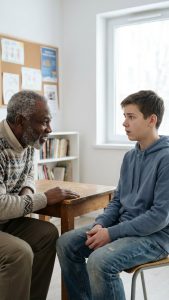
Among the volunteers was an elderly man named Mr. Kweku, a gentle presence with kind eyes and a voice that carried wisdom even when he was silent. He never pushed me to explain anything. Instead, he sat beside me daily and taught me mathematics and English with a patience I had never experienced.
When my thoughts wandered into old fears, he would hum quiet African melodies that seemed to steady the air around us. “Pain can make you strong,” he told me once. “But only if you grow beyond it, not carry it like a shadow.” I didn’t understand then, though I held onto his words.
Months later, after a study session, he cleared his throat and told me something that froze me completely. He said he wished to adopt me—if I would allow it. I didn’t know how to answer a question no one had ever asked me, because no one had ever chosen me before.
“Why?” was all I could whisper. He smiled in a careful, warm way and said, “Because you deserve a home, and I believe I can give you one.” I cried in a way that felt like release instead of fear, and that moment quietly changed the direction of my life forever.
Living with him was like learning what a real home felt like. His grown daughters visited often with their families and welcomed me instantly, calling me their little brother. He supported my schooling, bought me clothes that actually fit, and, most importantly, listened when I spoke.
He told me repeatedly that I was not the words others had used to define me. He said I had the right to choose who I became. Slowly, the pieces inside me that had been cracked for years began to knit themselves together with something like hope.
I finished secondary school, entered university, and worked harder than I thought I could—not out of revenge, but from the quiet belief that I could build a life no one could take from me. When I graduated, he cried with pride and called me “my son,” and the word felt like healing.
Years later, after I had a job and a small apartment, I received a message from a number I did not recognize. I ignored it until the buzzing continued. When I finally opened it, I found a series of messages from my uncle—the man who had once erased me without hesitation.
He wrote that he was sick, that his children had abandoned him, and that he had no one left. He asked for forgiveness and help with hospital bills. Seeing his words stirred something heavy in me, a mix of old wounds and new confusion that left me unable to reply.
Two days later, when I sat quietly in my living room, Mr. Kweku visited. He noticed my silence immediately and asked what troubled me. I handed him my phone. He read the messages slowly and nodded, as if he had expected this moment to arrive eventually.
“What do you want to do?” he asked. I told him I didn’t know. He said forgiveness was not about the person who hurt you—it was about freeing yourself from the weight of their damage. “But helping him doesn’t mean forgetting,” he added. “And forgiveness does not mean letting him close again.”
That night I thought about everything: the cruelty, the loneliness, the nights I prayed for love, and the life I had built since then. Most of all, I thought about the man who adopted me and showed me what compassion looked like in practice, not just in words.
By morning, I understood something important. I wasn’t acting as the frightened boy anymore. I was making a choice as the man I had grown to be. So I typed a message that offered forgiveness, a small amount of help, and a firm boundary that I would not cross.
It wasn’t reconciliation. It wasn’t revenge. It was closure. A way to finally put down a burden I had carried since childhood. He replied with gratitude and more requests, but I did not answer. I had already given the only part of myself I was willing to offer.
For the first time in my life, I felt a quiet, unmistakable lightness—as if a chain I hadn’t realized I still wore had finally fallen away. I chose compassion without surrendering my peace. I chose forgiveness without reopening the door to harm. I chose to be who I had become, not who I had been.
And that, I realized, is the greatest victory anyone can claim:
becoming the person your past tried to prevent.