
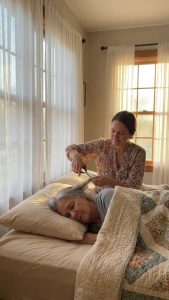
My daughter-in-law snuck into my room while I was asleep and cut my hair. When I jolted awake, stunned and disoriented, she stood there with the scissors still in her hand and said, almost playfully, “Now you finally understand your place.” And when I turned to my son for help, he didn’t even hesitate.
“Mom,” Ethan said flatly, “maybe this is the lesson you need.”
I said nothing. Not then. Not while my heart was pounding like a fist in my chest. Not while I stared at the pile of silver strands on the hallway floor that used to be my braid.
But I carried their words with me for three long days.
And on the fourth afternoon, I invited Lauren to sit in the living room of the home I’ve lived in for thirty years and told her, calmly, “You have thirty days to leave my house.”
That sentence didn’t come from anger—it came from the moment everything shifted.
My name is Patricia. I’m fifty-eight years old, a widow, and this small house in Queens is the last promise my husband and I built together. My braid was the one thing I kept unchanged after he died… the one habit that still felt like him. For years, he used to brush and braid my hair on Sunday afternoons while the Yankees played softly on the TV. After the heart attack stole him from me, the braid became the closest thing to holding his hand.
When Ethan married Lauren and asked if they could stay “until they found their footing,” I said yes before he finished the question. I cooked bigger meals, set extra plates, stocked their favorite snacks. I convinced myself that the tension in the house was just growing pains.
Lauren made little comments at first—tiny cuts disguised as jokes.
“People in New York dress nicer, Patricia. You should try it sometime.”
“No one your age keeps their hair that long. It looks outdated.”
Ethan would scroll on his phone and laugh softly, never noticing how those small comments landed. I told myself to ignore it. Mothers always do—they absorb the sting and keep going.
Then came that Sunday.
I had been up since dawn, roasting turkey and whipping potatoes, wanting them to walk into a home that smelled like comfort. After the dishes were washed, I lay down upstairs “just for a few minutes.”
When I woke, I sensed something immediately—my head felt strangely light. My hand reached back and touched nothing but jagged ends.
In the bathroom mirror, the woman staring back at me looked like she’d been robbed. My hair, the braid I had treated gently for decades, was hacked off unevenly.
On the floor lay the strands Lauren had cut—discarded like they meant nothing.
When I walked downstairs and confronted them, she smiled at me as though she’d done me a favor.
“Now you know your place,” she said.
And my son—my only child—stood beside her and nodded.
“Mom, don’t overreact,” he said without getting up from the armchair. “You were too old to have your hair that long. It made you look out of date. Lauren just wanted to help you.”
Help me. That word cut through me like a knife. I swallowed my tears. I went back to my bedroom. I closed the door. And there, in front of the mirror, with my ruined hair falling in uneven clumps on my shoulders, I made a decision.
But that comes later, because what I did three days later brought them to their knees in front of me, crying, begging for forgiveness. And I still wonder if I did the right thing.
Has anyone you trusted ever done something to you that you never imagined? Tell me your story in the comments. I want to read it.
Before I tell you what happened next, I need you to know me. I need you to understand who I was before that Sunday afternoon.
My full name is Patricia Riley Mendoza. I was born in Philadelphia into a family of textile merchants. My father owned a store that sold fine fabrics downtown. I grew up among rolls of silk, linen, and Egyptian cotton. I learned from childhood that quality things are cared for, respected, and preserved.
When I was 23, I met Robert Mendoza at a wedding. He was a civil engineer, ten years older than me, a serious, hardworking man of his word. We got married six months later. It was one of those marriages that don’t exist anymore, one that is built slowly with coffee in the mornings and long conversations on the balcony.
Robert and I bought the house in Westwood when Ethan was barely two years old. It was a two-story house with a backyard where I planted bugan villas, jasmine, and a lemon tree that still bears fruit every spring. Ethan learned to walk there. We celebrated his birthdays there. Robert and I grew old together there.
My hair, my long hair, was part of that life. Robert would braid it for me on Sundays while we watched old movies. He said it was the most beautiful thing about me. When he died five years ago from a sudden heart attack, I decided never to cut it. It was my way of keeping him close. Every morning, as I brushed those long silver strands, I felt that Robert was still there somewhere.
Ethan was our only son. We loved him completely, maybe too much. When he finished high school, we paid for his private university. He studied business administration, though he never really found his path. He had several jobs. None of them lasted long. There was always a reason. The boss was unfair. The hours were too tough. The salary wasn’t enough.
Then he met Lauren at a party. She was younger, from a family outside of New Jersey. At first, I thought she was nice. She talked a lot, laughed loudly, wore tight clothes and expensive perfumes. But there was something in her eyes, something I couldn’t decipher.
They got married quickly, very quickly. And when Ethan told me they needed a place to live while they got settled, I didn’t hesitate. The house was big. I lived alone. I thought it would be wonderful to have company again, that I would prepare family meals on Sundays, that the house would once again smell of sweet rolls and brewed coffee in the mornings.
I also began to help them financially. Two thousand dollars monthly. It wasn’t a small amount, but it didn’t hurt me either. Robert left me a good pension and some savings. I thought, He’s my son. It’s my blood. Why do I need the money if not to help him?
The first few months were good. Lauren cooked sometimes. Ethan hugged me and said:
“Thank you, Mom. I don’t know what we’d do without you.”
But little by little, something changed. Lauren started making comments. Small, subtle, like invisible needles.
“Oh, mother-in-law, are you going out like that? That dress is out of style.”
“Patricia, no offense, but your cooking is very traditional. People eat lighter now.”
“Do you still use that cream? There are much better ones at the spa I go to.”
Ethan didn’t say anything. He just nodded, or worse, laughed. And I kept silent because a mother always finds a way to justify her children. I thought, They’re young. They’re stressed. They’re adjusting.
But that afternoon, when I woke up without my hair and heard those words, cold as ice—”That’s how you learn your place”—I knew there was no possible justification anymore. Something inside me broke. And when something breaks in a 58-year-old woman who has given everything, who has loved without limits, who has forgiven tirelessly, it doesn’t repair in the same way.
Did you ever allow someone to cross your boundaries just for love? Write it in the comments. You are not alone.
Fractures never happen all at once. They arrive as small cracks in a wall you thought was solid. And when you finally realize it, it’s too late. The wall is about to fall.
That Sunday night, after what happened with my hair, I didn’t leave my bedroom. I didn’t go down for dinner. I didn’t want to see anyone. I sat on the edge of my bed, my hands trembling, picking up the strands of hair that had fallen onto the pillow. There was so much—long, silver, soft clumps. Thirty years of care, loosely clutched on the white comforter Robert gave me for our 20th anniversary.
I heard laughter downstairs. Laughter. Lauren and Ethan were watching television as if nothing had happened. As if cutting a woman’s hair while she sleeps was normal, something unimportant.
I tried to cry, but I couldn’t. There was something stronger than tears. Something cold and dense was settling in my chest. I didn’t know what it was yet, but I felt it growing.
The next morning, Monday, I got up early. I looked in the mirror again. My hair was still there, short, uneven, like an open wound. I tried to fix it with my hands, but there was no way. I would have to go to a salon. I would have to explain to someone what had happened. And that embarrassed me.
How do you tell a stylist that your own daughter-in-law cut your hair while you were sleeping? How do you explain that your son did nothing to stop it?
I walked down the stairs slowly. Lauren was in the kitchen drinking coffee, looking at her cell phone. She was wearing a pink silk robe that I had never seen before. Surely expensive. Surely bought with the money I gave them every month.
“Morning, mother-in-law,” she said without looking up.
I didn’t answer. I poured my coffee in silence. My hands were shaking so much that I spilled a little on the table.
Lauren sighed.
“Oh, Patricia, don’t take it so personally. It was just hair. It’ll grow back.”
Just hair. Thirty years of memories. Thirty years of Robert braiding it carefully. Thirty years of identity. And to her it was just hair.
I wanted to say something. I wanted to scream that she had no right, that this was my house, that I was supporting them. But the words wouldn’t come out. I stood there in front of the stove, feeling the coffee cool in my hands.
Ethan came down half an hour later. He was freshly showered, wearing that cologne he always used and which I bought him every Christmas. He saw me and smiled.
“Morning, Mom. Sleep well?”
Sleep well. As if nothing. As if my life hadn’t changed the day before.
“Ethan,” I said with the firmest voice I could manage. “I need to talk to you.”
He poured himself orange juice. He sat down at the table.
“Tell me.”
“What happened yesterday. What Lauren did was not okay.”
Lauren looked up from her cell phone, her eyes narrowed.
“What wasn’t okay, mother-in-law? Helping you look better? Getting rid of that outdated old lady look?”
“You didn’t ask my permission,” I said, feeling my voice break. “You came into my bedroom while I was sleeping. You cut my hair without my consent. That’s not helping. That’s—”
“That’s what?” Lauren asked, standing up. “Violence, abuse? Please, Patricia, don’t exaggerate. I did you a favor. And if you can’t see that, the problem is yours.”
I looked at Ethan. I waited for him to say something, to defend me, to say, “Lauren, my mom is right. What you did was wrong.”
But he didn’t say any of that.
“Mom,” he said in a tired tone. “Seriously, that’s enough. It’s over. Don’t turn this into a drama. Lauren just wanted to help you. Besides, you were too old to have your hair that long. It was, I don’t know, weird.”
Weird. My hair, my identity, my way of keeping Robert alive. It was weird.
I felt something detach inside me. Like when an old root lets go of the earth and there’s no way to plant it again.
I didn’t say anything else. I went upstairs. I grabbed my purse. I left the house. I walked to the avenue and took a cab. I asked the driver to take me to the hair salon where I had been going for years, a small, discreet place where Mrs. Martha always treated me with kindness.
When I walked in, Martha saw me and her face changed.
“Oh, Patricia, what happened?”
I told her everything, word for word. And as I spoke, I felt the tears finally begin to fall. I cried as I hadn’t cried in five years, since Robert’s death.
Martha didn’t say anything. She just hugged me. Then she sat me down in the chair. She washed my hair with warm water and lavender oil, and she began to fix it.
“We can’t save everything,” she said softly. “But I’m going to make it look the best I can.”
When she finished, I looked in the mirror. It wasn’t me anymore. Or rather, it was a version of me I didn’t know. The short hair barely below my ears made me look different, older, vulnerable, but also something else—something I didn’t understand yet.
“Thank you, Martha,” I said.
She squeezed my shoulder.
“Patricia, listen to me closely. I’ve seen a lot in my life. And what they did to you is not normal. It’s not love. It’s control. And if you don’t set boundaries now, they are going to keep taking pieces of you until there’s nothing left.”
Her words stayed with me all the way back home.
When I arrived, the living room was empty. I went up to my bedroom and locked the door. I sat on the bed. I took a manila envelope from my dresser where I kept important documents—deeds, bank papers, my will—and there, in silence, I began to read.
The house was in my name completely. Robert left it to me in the will. Ethan had no legal right to it. None. I also checked my bank statements, the $2,000 monthly I transferred to Ethan’s account. Twelve months a year, $24,000 total over the two years they had been living with me.
I closed my eyes. I took a deep breath. And I made a decision, but I wouldn’t act immediately. No, that would be emotional, impulsive. I wasn’t like that. I had learned from Robert that important decisions are made with a cool head, with clarity, with strategy.
I would wait three days. Three days to make sure this wasn’t just pain. Three days to confirm that there was no turning back. Three days to see if Ethan, my only son, the boy I had carried in my arms, would apologize, if he would show even a little remorse. But deep down I already knew the answer.
That night during dinner, Lauren prepared pasta. She sat at the table as if she were the owner of the house. Ethan talked about a new business he wanted to start. He needed money. More money.
I ate in silence. I watched them. I laughed when it was time to laugh. I nodded when it was time to nod. But inside something had changed, and they didn’t know it yet.
As I tell all this, I think about where you might be listening to me. Type the name of your city in the comments. I want to know I’m not alone in this.
The next two days were strange, like living in a play where everyone pretended that nothing had happened. I pretended everything was fine. Lauren pretended she had done me a favor. And Ethan, Ethan pretended that his mother wasn’t broken inside.
On Tuesday morning, I woke up early as always. I prepared breakfast: rancherero eggs, refried beans, freshly made tortillas. The smell filled the whole house. It was a smell that reminded me of my childhood, of mornings in Philadelphia, of when my mother taught me to cook on that clay griddle.
Lauren came down at 10:00. She was wearing one of those designer pajamas they sell at luxury department stores. She sat at the table and looked at the plate I had served her.
“Oh, mother-in-law. Beans again. I told you I’m watching my figure. This has too many calories.”
I didn’t say anything. I took the plate away. I prepared a green smoothie for her just the way she liked it: strawberries, spinach, banana, almond milk. I blended it slowly, feeling how every movement of my hands was mechanical, automatic.
She didn’t even say thank you.
Ethan appeared half an hour later. He kissed Lauren on the forehead. He barely looked at me.
“Mom, can you iron my blue shirt? I need it for an interview.”
“Of course, son.”
I went up to his bedroom. The bed was unmade. Clothes were strewn on the floor. Empty water bottles on the nightstand. I picked up everything. I made the bed. I ironed the shirt. I folded his clean clothes. And as I did it, I asked myself, When did I stop being his mother and become his maid?
When did that happen?
I didn’t remember the exact moment. It had been gradual. So gradual that I didn’t notice. First it was, “Mom, can you help me with this?” Then it was, “Mom, do this for me.” And finally, it was, “Mom, I need you to do this now.”
And I always said, “Yes,” because that’s what mothers do, right? They sacrifice themselves. They disappear. They become shadows so their children can shine. Or so I believed.
That afternoon, while cleaning the living room, I found something under the sofa. A real estate magazine. It was marked with yellow marker on several pages. Condos in Manhattan, houses in Brooklyn, high prices, very high. There was a handwritten note in the margin, Lauren’s handwriting:
“With the sale of the old lady’s house, this is perfectly affordable. Three bedrooms, terrace, gym. Ethan, what do you think?”
The old lady. That’s what she called me. And they were planning to sell my house. The house Robert and I bought together. The house where my son grew up. The house where my memories were, my bugan villars, my lemon tree. They wanted to sell it.
I slowly closed the magazine. I put it back under the sofa, exactly where I had found it. My hands weren’t shaking anymore. I didn’t feel like crying anymore. I felt something worse, something cold, something I had never felt before: clarity.
That night, I prepared dinner. Chicken and dumplings, white rice, handmade biscuits. It took me three hours. Three hours where my hands moved on their own, where my mind went over that phrase written in yellow marker again and again: “with the sale of the old lady’s house.”
When Ethan and Lauren sat down for dinner, I observed them. I really observed them as if I were seeing them for the first time. Lauren ate quickly, checking her cell phone between bites. Ethan talked about the job interview. It hadn’t gone well. It never went well. There was always an excuse.
“The guy was an idiot, Mom. He asked me absurd things. As if I didn’t know how to do my job.”
“Relax, son. Something better will come along.”
He sighed.
“Yeah, but in the meantime, Mom, do you think you could increase the help a little this month? We need to buy some things for the house.”
For the house. My house. The one they wanted to sell.
I smiled.
“How much do you need?”
“I don’t know. About $500 extra. Just this month.”
Just this month. The same phrase I had heard for the last six months.
“Sure, son. I’ll transfer it to you tomorrow.”
Lauren looked up from her cell phone and stared at me. There was something in her eyes, something close to triumph, as if she had won something.
“Thank you, mother-in-law. You’re very generous.”
Generous.
We finished dinner. I cleared the dishes. I washed everything. I cleaned the kitchen. I went up to my bedroom. And there, sitting on my bed, I took out the documents again—the deeds, the bank statements, Robert’s will. There was a letter, too. A letter Robert left me before he died. He had written it when he knew his heart was failing, when he knew he didn’t have much time left.
I opened it carefully. I hadn’t read it in months.
“My dear Patricia, if you are reading this, it is because I am no longer with you. And although it hurts me to leave you, I know you are strong, stronger than you think. I leave the house to you because it is yours. We built it together. It is your sanctuary. Don’t let anyone take it from you. Not even Ethan. Love him. Guide him. But don’t let him consume you. Sometimes the greatest love we can give is to say no. Because saying yes to everything is not love. It is fear. It is cowardice. Be brave, my love. Be the woman I always admired. Yours always, Robert.”
I closed the letter. The tears finally came. But they weren’t tears of sadness. They were tears of rage, of shame, of recognition. Robert was right. I had been afraid. Afraid that Ethan would leave me. Afraid of being alone. Afraid of losing the only piece of family I had left. And that fear had turned me into this, into a woman who allowed her hair to be cut while she slept, into a woman who cooked, cleaned, and paid bills while they called her the old lady and planned to sell her house.
No more.
Wednesday dawned cloudy. It had rained in the early hours, and the backyard smelled of wet earth. The red bugan villas glistened with raindrops, still clinging to their petals. I ate breakfast alone. Black coffee, no sugar. I needed to feel the bitter taste. I needed to stay awake, alert.
Lauren appeared at noon.
“Mother-in-law, I’m going out. I’m going to the spa with some friends. Don’t wait up for lunch.”
“Have fun.”
Ethan left shortly after. Another interview. Another opportunity that probably wouldn’t work out.
I was alone in the house. And there, in the silence of my own living room, I picked up the phone. I dialed the number of my lawyer, Mr. Wallace, an older man who had worked with Robert for years.
“Mr. Wallace, it’s Patricia Mendoza.”
“Mrs. Patricia, how nice to hear from you. How are you?”
“I need to see you tomorrow. It’s urgent.”
“Of course. What time works for you?”
“10:00 in the morning. And Mr. Wallace, I need you to prepare some documents, an eviction notice, and I want to cancel a recurring bank transfer.”
There was a silence on the other end of the line.
“Mrs. Patricia, are you sure?”
“Completely sure.”
I hung up the phone. My hands weren’t shaking anymore. My heart was beating steadily. Calm. Tomorrow would be Thursday, the third day, and that day would change everything.
I still ask myself if I made the right decision. What about you? What would you have done in my place? Tell me in the comments.
Thursday dawned with a clean sky, one of those blue New York skies that look freshly washed. I hadn’t slept well. I spent the night tossing and turning, mentally going over every step I would take that day. I got up at 6:00 in the morning. I showered slowly. I chose my clothes carefully—a navy blue dress that Robert had given me for our last anniversary together, closed-toe shoes, a pearl necklace I inherited from my mother. I wanted to look dignified, firm, not like a defeated woman.
I went down to the kitchen and made coffee, only for myself. I didn’t make breakfast for anyone else. Lauren appeared at 9:00, yawning, her hair messy.
“Morning, mother-in-law. No breakfast?”
“I didn’t prepare anything today. I have to go out.”
She raised an eyebrow.
“Go out where, to?”
“Personal business.”
I didn’t say anything more. I grabbed my purse, my keys, and left. The fresh air hit my face. I took a deep breath. I felt my lungs fill with new, clean oxygen, as if I had been breathing stale air for days without realizing it.
I took a taxi to Mr. Wallace’s office. It was in the Midtown area in an old building that still had a cage elevator. I went up to the third floor. The secretary greeted me with a smile.
“Mrs. Mendoza, the attorney is waiting for you.”
I walked into the office. Mr. Wallace stood up. He was a man of almost seventy, gray-haired, with thick glasses and an always kind expression.
“Mrs. Patricia, please come in. Have a seat.”
I sat down across from his dark wooden desk. There were papers piled everywhere, law books on the shelves, a photograph of his wife in a golden frame.
“Mr. Wallace, thank you for seeing me so quickly.”
“For you, always. Besides, I must confess that your call worried me. You never ask for anything urgently.”
I took a deep breath.
“I need you to prepare two documents. The first is an eviction notice. I have two people living in my house without a lease agreement. I want them to leave.”
He picked up his pen. He began to write.
“Names?”
“Ethan Mendoza Riley, my son, and Lauren Campus Mendoza, his wife.”
The pen stopped. The attorney looked up.
“Your son?”
“Yes.”
There was a long silence. I could see him processing the information, trying to understand what had happened for a mother to reach this point.
“Mrs. Patricia, are you sure? A decision like that is complicated. Emotionally complicated.”
“I am sure.”
“May I ask what happened?”
I told him everything from the day I woke up without my hair to the magazine I found under the sofa. I told him about the $2,000 a month, about how I felt in my own house, about what they called me, about how they planned to sell it. As I spoke, I felt the words come out easier than I expected, as if I had been waiting months to say them out loud, for someone to hear them, for someone to validate what I was feeling.
Mr. Wallace didn’t interrupt me. He listened to everything. When I finished, he took off his glasses and cleaned them with a handkerchief.
“Mrs. Patricia, what you are telling me is serious. Very serious. Not just legally—morally.”
“I know.”
“The house is completely in your name. You have every right to ask them to leave. But there is a process. Legally, I must give them 30 days notice.”
“Thirty days.”
“Yes, that’s the law. But I can prepare the document today. I will deliver it personally tomorrow if you wish.”
I nodded.
“And the bank transfer?”
“That’s simpler. You can cancel it immediately today if you want. I just need you to sign an authorization and I will take care of everything with the bank.”
He took out a document. I read it carefully. It was a cancellation of an automatic transfer. I signed without hesitation.
“Done,” I said. “Cancel it.”
He took the paper. He put it in a folder.
“Mrs. Patricia, I must ask you something else. Do you have somewhere to stay if this gets complicated?”
“It’s my house, Mr. Wallace. I’m not leaving.”
“I understand. But sometimes, when there are family conflicts, things can get tense, even violent.”
“My son has never laid a hand on me until now. But when people lose money or privileges, they can change. I just want you to be prepared.”
His words struck a chord. Not because I thought Ethan was capable of physically hurting me, but because I realized I no longer knew what my son was capable of. I no longer knew him.
“I have friends,” I finally said. “If things get complicated, I can go away for a few days.”
“Perfect. Then tomorrow, Friday, I will deliver the eviction notice. Do you want me to go personally or would you prefer I send someone?”
“I prefer you go.”
“Very well. I will go at 11:00 in the morning. Will they be home?”
“They are always home.”
I left the office with a strange feeling in my chest. It wasn’t relief. It wasn’t sadness. It was resolution. Like cutting a dead branch from a tree so it doesn’t infect the rest.
I walked down Broadway. I passed coffee shops, bookstores, clothing stores. People came and went, everyone with their own lives, their own problems. And I, I was just one more woman walking through the city. But inside, something had changed.
I entered a small coffee shop. I ordered an Americano and a piece of cornbread. I sat by the window. I watched the street, the trees, the old buildings with their colorful facades. And I thought about Robert, about how he would have handled this situation.
Robert was firm, but fair. Never cruel, never vengeful. But he also wouldn’t let himself be trampled. “Sometimes the greatest love we can give is to say no.” I remembered his words from the letter.
I took out my cell phone. I had three missed calls from Lauren, none from Ethan. Not a single one from my own son. I didn’t return the calls.
I returned home at 4:00 in the afternoon. When I walked in, Lauren was in the living room watching television. She looked at me annoyed.
“Where were you? I called you a thousand times.”
“I had things to do.”
“What things?”
“My things.”
She frowned.
“You’re really weird, mother-in-law. Is something wrong?”
“No, nothing is wrong.”
I went up to my bedroom. I closed the door. I sat on the bed.
Tomorrow. Tomorrow, Mr. Wallace would arrive with the papers. Tomorrow, Ethan and Lauren would know they had 30 days to leave. Tomorrow they would realize that the $2,000 transfer would no longer arrive. Tomorrow the real conflict would begin.
That night during dinner, I acted as always. I prepared quesadillas, refried beans, green salsa. I served the plates. I sat at the table. Ethan talked about a new project, a business idea he had. He needed investment. He needed money.
“Mom, I’ve been thinking. If we sell this house and buy something smaller, we could use the difference to invest. I could start a business, something that finally works.”
Lauren nodded enthusiastically.
“Yes, mother-in-law. There are super nice condos in Manhattan. More modern, more practical. This house is too big for you alone anyway.”
For me alone. As if they didn’t live here.
“We’ll see,” I said simply. “We’ll see.”
Lauren looked at me strangely.
“What is there to see? Ethan is right. This house is too much and you don’t need it.”
I took a sip of water. I looked at both of them—my son, the woman he had chosen—and I felt nothing. Neither love nor hatred, just distance.
“We’ll talk about it tomorrow,” I said.
And in my mind, I added, Tomorrow you will know that none of this belongs to you. Not the house, not my money, not me.
I went to sleep early. For the first time in days, I slept deeply, without nightmares, without tears, because I knew that what was coming was inevitable and I was ready.
Have you ever had to set a boundary so huge that it hurt your soul? Tell me about it. I need to know I’m not crazy for doing this.
Friday dawned with a clear sky. I don’t know if it was the sky, which had that golden tone you only see in October, or if it was me who had changed, but something in the air felt different, like before a storm, when everything is too quiet and you know something big is coming.
I got up at 6:30 in the morning. I took a long bath. I let the hot water fall on my back while I thought about everything that was about to happen. I dressed carefully again: beige linen pants, a white cotton blouse, comfortable shoes. I wanted to look serene, in control.
I went downstairs and made coffee, only for myself. I no longer felt obligated to cook for them. I no longer felt obligated to anything. I sat in the dining room facing the window that looked out onto the backyard. The red bugan villas swayed in the breeze. The lemon tree had new fruits, small, green, promising. That tree had survived droughts, frosts, pests, and it kept bearing fruit every year. I would survive this, too.
At 9:00 in the morning, Lauren came downstairs. She was wearing a peach-colored satin robe. Her hair was pulled up in a messy bun. Mascara was smudged under her eyes.
“Morning, mother-in-law. Is breakfast ready?”
“I didn’t make anything.”
She huffed.
“Oh, what is wrong with you now? Are you mad or something?”
“I’m not mad.”
“Then why are you acting so weird? You’ve been acting super strange for days. Is it still about the hair? Just get over it, Patricia. It was just hair.”
Just hair. That phrase again.
I didn’t respond. I drank my coffee in silence. She poured herself cereal straight from the box without a bowl, standing in front of the refrigerator, as if this were her house, as if I didn’t exist.
Ethan appeared at 10:00. He was in sweatpants and a T-shirt. His hair was messy. He smelled of expensive cologne, the one I bought him every month.
“Morning,” he said, yawning. “Mom, can you make me some eggs?”
“Not today, son. I have a visitor.”
“A visitor? Who is coming?”
“Mr. Wallace.”
Ethan frowned.
“Dad’s lawyer? For what?”
“Legal matters.”
“What legal matters?”
“You’ll know when he arrives.”
Lauren stopped chewing. She looked at me with suspicion.
“Legal matters? What are you talking about, Patricia?”
“You’ll find out in a little while.”
I got up from the table. I went up to my bedroom. I needed to be alone for a few minutes before the attorney arrived. I needed to mentally prepare myself for what was coming.
I sat on the edge of my bed. I looked around. This room had been my refuge for 30 years. I had slept here with Robert. I had cried his death here. I had dreamed here. I had been cut here while I slept. I couldn’t continue living like this. I couldn’t continue to be invisible in my own house.
At 11:00 sharp, the doorbell rang. I walked down the stairs slowly. Ethan and Lauren were in the living room now, looking curious, worried. I opened the door. Mr. Wallace was there in his gray suit with his leather briefcase and his serious expression.
“Good morning, Mrs. Patricia.”
“Good morning, Mr. Wallace. Come in.”
He walked in. Ethan stood up. He extended his hand.
“Mr. Wallace, how good to see you. How are you?”
“Well, Ethan, thank you.”
“What brings you here?”
The attorney looked at me. I nodded.
“I’ve come to deliver some documents. May we sit down?”
“Of course, of course,” Ethan said, confused.
We all sat down in the living room. I was in the individual armchair. Ethan and Lauren on the large sofa. The attorney in the other armchair with his briefcase on his lap. He took out two envelopes, one for Ethan, the other for Lauren.
“These are for you,” he said in a firm but kind voice. “They are official documents. I recommend you read them carefully.”
Ethan took the envelope. He opened it slowly. He took out the papers. He began to read, and I watched his face change—how it went from confusion to surprise, from surprise to shock, from shock to disbelief.
“What is this?” he asked in a trembling voice. “An eviction notice?”
Lauren snatched the paper from his hands. She read quickly, her eyes widened.
“You’re kicking us out? You’re kicking us out of your house?”
“It’s not your house,” I said calmly. “It’s my house.”
“And yes,” I said, “I’m asking you to leave.”
“What?” Lauren stood up. “This is crazy. You can’t do this. We’re family.”
“Family?” I repeated the word as if tasting it for the first time. “Is family cutting someone’s hair while they sleep? Is family calling me the old lady? Is family planning to sell my house without my permission?”
Lauren paled.
“What are you talking about?”
“I found the real estate magazine under the sofa with your handwriting: ‘with the sale of the old lady’s house. Perfectly affordable.’ Does that ring a bell?”
She opened her mouth. She closed it. She didn’t say anything.
Ethan was still seated with the paper in his hands, reading and rereading as if he couldn’t believe what it said.
“Mom. Mom, this can’t be serious. We’re your family. I’m your son.”
“I know, Ethan. You are my son and that’s why it hurts so much to do this.”
“Then why? Why are you doing it?” His voice broke. “If the hair thing bothered you, Lauren can apologize. If she said something that offended you, we’ll fix it. But this—this is too much.”
“Too much?” I stood up. “Do you know what’s too much, Ethan? Too much is living in my house without paying rent. Too much is receiving $2,000 every month without working. Too much is treating me like I’m a maid. Too much is planning to sell my house behind my back.”
“We never planned to sell anything,” Lauren yelled. “That magazine was just an idea, a conversation. It’s not a crime.”
“You’re right. It’s not a crime, but it is a massive lack of respect. An enormous lack of respect.”
Mr. Wallace cleared his throat.
“Allow me to explain the legal process. You have 30 days to vacate the property. After that period, if you have not left voluntarily, we will proceed with a judicial eviction. I must also inform you that the monthly bank transfer of $2,000 has been cancelled as of today.”
Lauren let out an incredulous laugh.
“Cancelled? You’re canceling the money, too? Patricia, do you realize what you’re doing? You’re leaving us homeless.”
“No one is leaving you homeless. You have 30 days to find somewhere to live. And Ethan has hands. He can work.”
“But what if he doesn’t have a job?” Lauren shrieked. “How are we going to pay rent without money?”
“That is not my problem,” I said. And every word came out firm, clear. “You are adults. You have to learn to support yourselves.”
Ethan looked at me as if I were a stranger, as if he couldn’t recognize the woman standing in front of him.
“Who are you?” he asked in a choked voice. “My mom wouldn’t do this. My mom always supported us. She was always there. What happened to you?”
That question cut through me. Because he was right. I had always been there, always. But they had never been there for me.
“What happened to me?” I repeated. “I woke up. I opened my eyes. I understood that love is not sacrificing yourself until you disappear. That love is not allowing yourself to be trampled. That love, true love, also has boundaries.”
“But we’re your family,” Ethan insisted.
“I’m your only son.”
“And I am your mother. But that doesn’t mean you should treat me as if I don’t matter, as if I were an old piece of furniture taking up space.”
Lauren crossed her arms.
“This is ridiculous, Ethan. We’re not leaving. This woman is crazy. We can fight this legally. We’ve been living here for two years. We have rights.”
Mr. Wallace looked at her firmly.
“Mrs. Lauren, I suggest you consult with your own attorney, but I’ll tell you in advance that you don’t have a case. There is no lease agreement. You have not paid for utilities. Legally, you are guests, and the owner of the property has every right to ask you to leave.”
Lauren glared at him. Then she looked at me, and in her eyes, I saw something I had never seen before. Hatred. Pure hatred.
“This isn’t going to end here, Patricia. I swear to you, you’re going to regret this.”
“Perhaps,” I said, “but at least I’ll be able to regret it in my own house. In peace.”
Ethan put the papers on the coffee table. He stood up. His eyes were red. I don’t know if from rage or sadness.
“Are you really going to do this?”
“Yes.”
“There’s no way you’ll change your mind?”
“No.”
He nodded slowly, as if accepting something he didn’t want to accept.
“Okay, then I guess I have nothing more to say.”
He went up the stairs. I heard his bedroom door slam shut.
Lauren pointed a finger at me.
“You’re going to end up alone. You know that? Completely alone. And no one is going to be there when you get old and sick. No one.”
“I prefer to be alone than in bad company,” I replied.
She let out a bitter laugh. She grabbed her purse. She slammed the front door shut as she left.
The silence that remained was dense, heavy, but also liberating.
Mr. Wallace stood up.
“Mrs. Patricia, are you okay?”
I nodded.
“Yes, I’m fine.”
“You did the right thing. I know it’s not easy, but you did the right thing.”
“Thank you, Mr. Wallace.”
“If you need anything, anything at all, you call me.”
“All right.”
I walked him to the door. When he left, I closed it slowly. I locked it. And there, standing in the entryway of my own house, I allowed myself to breathe, to really breathe.
I didn’t cry. I didn’t feel like crying. I felt relief, like taking off a shoe that has been pinching all day. Like letting go of a weight you had been carrying without realizing it.
I went up to my bedroom. I lay down on the bed. I closed my eyes and I thought about Robert, about how he would be proud of me, about how he would say, “Well done, my love. Well done.”
That afternoon, Ethan did not leave his room. Lauren returned at dusk. I heard them talking loudly, arguing, searching for solutions that didn’t exist. I stayed in my bedroom reading, drinking chamomile tea, watching the sky turn orange and pink outside the window. And for the first time in a long time, I felt like the owner of myself.
At 9:00 at night, someone knocked on my bedroom door.
“Mom.”
It was Ethan.
“Come in.”
He entered slowly. His eyes were puffy, his face pale.
“Can we talk?”
“Of course.”
He sat in the chair by the window. I remained lying on the bed, my book resting on my chest.
“Mom, I—I didn’t know you felt this way. I really didn’t know.”
“You didn’t know I was hurt that my hair was cut without my permission?”
“Yes. Well, that. But I thought you would get over it quickly. I thought you were exaggerating.”
“I wasn’t exaggerating, Ethan. That hair was important to me. It was my connection to your father. It was my identity. And Lauren cut it as if I didn’t matter. And you? You defended her.”
He looked down.
“I’m sorry. I really am sorry.”
“Are you sorry for what happened, or are you sorry because there are consequences now?”
He looked up. He stared at me.
“Does it matter?”
“Yes, Ethan. Yes, it matters.”
There was a long, awkward silence.
“Mom, we have nowhere to go. We don’t have any savings. I—I haven’t been able to find a job. I don’t know what we’re going to do.”
“You have 30 days. That’s enough time to look for a job, to find a place, to start over.”
“And what if we can’t do it?”
“You will do it. You are intelligent. You are capable. It’s just that you’ve never had to try because I was always there to solve everything.”
“And now you’re not going to be?”
“Not in the way I was before. No.”
His eyes filled with tears.
“You don’t love me anymore.”
That question broke my heart.
“I love you, Ethan. I will always love you. You are my son. But loving you doesn’t mean allowing myself to be disrespected. Loving you doesn’t mean erasing myself. Loving you doesn’t mean losing myself.”
“Then what does it mean?”
“It means letting you grow, letting you fall, and trusting that you can pick yourself up alone.”
He wiped his tears with the back of his hand.
“I don’t know if I can.”
“I know you can.”
He stayed seated there for a few more minutes. Then he stood up.
“Mom, is there any way to fix this? To make you reconsider?”
I thought about it. I really thought about it.
“Maybe. But not now. Now I need you to leave. I need my space. I need my house. I need my life back.”
He nodded. He left without saying anything else. And I stayed there in my bedroom, feeling something inside me settle, like broken bones finally beginning to heal.
Outside, the night was full of stars. The lemon tree swayed in the wind. The red bugenvvils shone under the moonlight. And I, Patricia Riley, 58 years old, felt that I was finally finding my way back to myself.
Do you think I was too harsh, or do you think I did the right thing? I need to know what you think. Leave me your comment.
The following days were like living in a divided house. Them in their world, me in mine. We shared the same roof, but we breathed different air. On Saturday, Ethan and Lauren left early. They didn’t tell me where they were going. I didn’t ask. I took the opportunity to clean the house, not because I had to, but because I needed to keep my hands busy. I needed to feel like I was doing something productive while my mind processed everything that had happened.
While dusting the living room furniture, I found more things. A receipt from an expensive restaurant in Beverly Hills. Three hundred dollars for a single dinner. A bag from a luxury boutique on Fifth Avenue. Two thousand five hundred dollars on clothes. All paid for with the credit card I had given them for emergencies.
Emergencies.
I put the receipts in a box, not to complain to them, not to fight, just to remind myself that I had made the right decision.
That afternoon, while watering the plants in the backyard, my friend Roberta arrived. Roberta and I had known each other for 20 years. She was a middle school teacher, a widow like me, a 62-year-old woman with completely white hair and a contagious laugh. I had told her on the phone what was happening, and she, without me asking, showed up with a bag of pastries and a thermos of coffee.
“I came to keep you company,” she said simply.
We sat in the backyard under the shade of the lemon tree. The afternoon sun made everything shine with a golden light. The red bugan villars seemed more alive than ever.
“How are you?” Roberta asked.
“I don’t know. Sometimes I feel like I did the right thing. Other times I feel like I’m the worst mother in the world.”
“You are not the worst mother in the world, Patricia. You are a mother who finally set boundaries, who finally realized that she matters, too.”
“But he’s my son, Roberta. My only son.”
“And you are his only mother. But that doesn’t mean you have to sacrifice yourself until you disappear.”
I took a sip of coffee. It was perfect, with the exact amount of sugar. Roberta always knew how I liked it.
“Do you know what the worst part is?” I said. “That Ethan hasn’t even really apologized. He came to my room yesterday. He cried. He said he didn’t know what to do. But he never said, ‘Mom, forgive me. I was wrong. I failed you.’”
“Because he still doesn’t understand. He still thinks that you are the one who is wrong, that you are the one who is being unfair.”
“And what if he’s right? What if I’m the one who is wrong?”
Roberta took my hand.
“Patricia, look at me. Do you think it’s okay for someone to cut your hair while you sleep?”
“No.”
“Do you think it’s okay for them to plan to sell your house without your permission?”
“No.”
“Do you think it’s okay for them to live off your money without working and without even thanking you?”
“No.”
“Then you are not wrong. You are setting boundaries, and boundaries hurt, especially when you never set them before.”
She was right. Roberta was always right.
We stayed there until the sun began to set, until the sky was painted orange and purple, until the first stars appeared. When she left, I felt less alone, less crazy, less guilty.
On Sunday, Lauren came looking for me. I was in the kitchen preparing chamomile tea when she walked in. Her hair was down. She had no makeup, with an expression I hadn’t seen on her before—something like vulnerability.
“Mother-in-law, I need to talk to you.”
“Tell me.”
She sat at the table. She played with her nails. Perfectly manicured nails with a French design and glitter. Surely done at an expensive salon.
“I—I know things haven’t been good between us.”
“No, they haven’t been good.”
“And I want you to know that, well, that I understand why you’re mad.”
“I’m not mad, Lauren. I’m disappointed. There’s a difference.”
She looked down.
“The hair thing was a mistake. I admit it. I shouldn’t have done it.”
“Why did you do it?”
There was a long silence, so long that I thought she wouldn’t answer.
“Why?”
“Because I was jealous.”
That answer took me by surprise.
“Jealous of what? Of me?”
“Of how Ethan loves you, of how he always talks about you, of how he always uses you as an example. ‘My mom did this, my mom said that, my mom cooked better.’ Always you. And I—I just wanted him to see me, to value me. For the first time since all this began, I saw Lauren for what she really was. An insecure woman. A woman who competed with a ghost. A woman who didn’t know how to build her own space without destroying others.”
“Lauren, I was never your competition. I never wanted to be.”
“I know. But that’s how I felt. And when I saw you with that long hair, so perfect, so cared for, so yours, I wanted to take it away from you. I wanted you to feel what I felt. Small, insignificant.”
“And now? How do you feel now?”
“Scared. We don’t have money. We have nowhere to go. Ethan is desperate. He cries at night. He doesn’t sleep. He doesn’t eat. And me? I don’t know what to do.”
“You can both look for work.”
“We are trying, but no one will hire Ethan. And me? I’ve never worked a formal job. I studied graphic design, but I never practiced. I always depended on my parents, then on Ethan, now on you.”
“Then it’s time for you to learn. It’s time for both of you to learn.”
She looked up. Her eyes were red.
“Is there no way you can forgive us? Give us another chance?”
I thought about it. I really thought about it.“Perhaps someday, but not now. Now I need you to leave. I need to reclaim my space, my life, my dignity.”
“And what if we can’t do it? What if we end up on the street?”
“You won’t end up on the street. You have family, friends, resources. You just have to stop expecting me to solve everything.”
Lauren nodded slowly and stood up. Before leaving, she stopped at the door.
“Mother-in-law… Patricia, I’m sorry. I really am sorry.”
“I know.”
And I think it was true. I think she did feel it. But sometimes apologies arrive too late, when the damage is already done, when the trust is already broken.
The following days passed in a tense calm. Ethan and Lauren began to pack slowly, with resentment, with pain. I watched them from afar. I didn’t offer help. I didn’t offer advice. I just watched.
One afternoon, while they were packing boxes in their room, Ethan came down to the living room where I was reading.
“Mom, we found an apartment in Queens. It’s small, old, but it’s what we can afford.”
“I’m glad you found something.”
“You’re glad?” His voice had a bitter tone. “Are you really glad to see us like this? Struggling, suffering?”
“I’m not glad to see you suffer, Ethan. But I am glad to see you struggle because it means you’re growing. That you’re learning.”
“Learning what? To hate my own mother.”
Those words cut through me like knives.
“If that’s what you feel, I can’t change it. But I hope that someday you understand that what I’m doing is not out of hatred. It’s out of love.”
“Love?” He let out a dry laugh. “This doesn’t look like love at all, Mom.”
“True love is not always pleasing. It’s not saying yes to everything. It’s not allowing yourself to be trampled. True love is also saying no. It’s setting boundaries. It’s teaching by example.”
“Well, your example is destroying me.”
He left without saying anything more. And I stayed there with the book open in my hands, feeling the tears finally begin to fall.
I cried. I cried like I hadn’t cried in days because it hurt. It hurt so much. It hurt to know that my son saw me as a villain. It hurt to know that he might never understand. It hurt to carry the guilt of a decision that I knew was right but felt terrible.
Roberta was right. Boundaries hurt, especially when you never set them before.
On the Wednesday of the following week, a moving truck arrived, small, old, with two men who loaded the few things Ethan and Lauren had. I stayed in my bedroom. I didn’t go down to say goodbye. I couldn’t. I knew that if I saw Ethan loading his boxes onto the truck, if I saw him closing the door for the last time, I would break. And I couldn’t break. Not yet.
I heard voices, footsteps, the sound of boxes dragging, the engine of the truck starting, and then silence.
I walked down the stairs slowly. The house was empty, completely empty. The bedroom they had occupied for two years was clean. The beds made, the windows open. They had left a note on the nightstand. I took it with trembling hands. It was Ethan’s handwriting.
“Mom, I don’t know if I will ever be able to forgive you for this, but I want you to know that despite everything, I love you. I will always love you. You are my mom, and nothing will change that. I hope that someday you understand the damage you did to us. I hope that someday you regret it, but also I hope that someday I understand why you did it. Take care, Ethan.”
I folded the note. I put it in the pocket of my blouse. I walked through the house. My house, now completely mine again.
I went out to the backyard. The red bugan villias were still there. The lemon tree was still bearing fruit. The air smelled of wet earth because it had rained in the early hours. I sat on the iron bench that Robert had installed years ago, the same bench where we used to sit on Sundays to drink coffee, the same bench where he used to braid my hair. And there, under the shade of the lemon tree, with the sun filtering through the leaves, I allowed the tears to come out.
I cried for everything. For the hair I lost. For the son who left. For the relationship that broke. For the woman I had to become in order to survive. But I also cried with relief, because I was finally alone. I finally had my house back. I finally could breathe without feeling like I was walking on eggshells.
I didn’t know if I had done the right thing. I didn’t know if Ethan would ever forgive me. I didn’t know if I would ever forgive myself. But I knew one thing, one thing with absolute certainty: I had recovered my dignity. And that—that was worth all the pain in the world.
Do you think a mother can love her son and still let him go? Tell me. Because I’m still asking myself.
The first few weeks after they left were the hardest. Not because I missed the chaos, not because I missed the tension, but because the house, my house, felt too big, too silent, too full of absences. I would wake up at 6:00 in the morning as always. But there was no one to cook for anymore. There was no one to serve anymore. There were no voices in the living room, no footsteps on the stairs, no doors slamming shut. Just me and my silence.
The first few days I cried a lot. I cried while I prepared coffee just for myself. I cried while I watered the plants in the backyard. I cried while I folded my clean clothes, aware that I was only folding mine, not anyone else’s.
Roberta came to visit me three times a week. She brought food. She brought company. She brought that laugh of hers that filled empty spaces.
“Have you heard anything from Ethan?” she always asked me.
“No, nothing.”
“Have you called him?”
“No.”
“Why not?”
“Because I need to give him space. I need him to process this in his own way. I need—I need him to decide for himself if he wants to talk to me again.”
Roberta nodded. She didn’t insist. She just squeezed my hand and served me more tea.
One afternoon, while cleaning the closet of the bedroom that had been Ethan’s, I found things they had left behind. A box with old photographs. Ethan as a baby. Ethan at his first communion. Ethan at his high school graduation. Robert holding him when he was three years old.
I sat on the floor surrounded by memories and I asked myself, At what moment did everything go wrong? At what moment did the child who was laughing in these photographs turn into the man who looked at me with resentment?
Perhaps it was gradual. Perhaps it was my fault. Perhaps I spoiled him too much. Perhaps I gave him everything without teaching him to value anything. Or perhaps—perhaps that’s just how things are. Sometimes children grow up, they leave. And sometimes when they come back, they are not the same. And neither are you.
I put the photographs away. I put them in a box marked with his name. Someday I would give them to him when he was ready, when I was ready. But not that day.
Weeks passed. October turned into November. The mornings were colder. The lemon tree began to lose some leaves. The bugan villias continued to bloom. Stubborn, beautiful, resilient.
I began to create a new routine. I got up early. I did yoga in the backyard as the sun rose. I prepared breakfasts just for myself. I read. I painted watercolors, something I had abandoned years ago. I visited museums. I went to coffee shops alone and enjoyed my own silence.
Slowly, very slowly, I began to feel whole again, as if I had been broken for so long that I no longer remembered what it felt like to be complete.
One Saturday morning, while having coffee in the backyard, my phone rang. It was an unknown number. I hesitated. I almost didn’t answer, but something made me respond.
“Hello?”
“Mrs. Patricia Mendoza?”
“Yes, that’s me.”
“Good morning. I’m calling from the city hospital. We have a patient who has you listed as an emergency contact. Ethan Mendoza Riley.”
My heart stopped.
“What happened? Is he okay?”
“He suffered a car accident. Nothing serious, but he has some bruises and a fractured arm. He’s stable. He’s asking for you to come.”
“I’m on my way. I’m coming right now.”
I hung up. I grabbed my purse, my keys. I ran out. The road to the hospital was endless. Saturday morning traffic was dense. My mind didn’t stop creating scenarios. What if it was more serious than they said? What if he was alone? What if he needed surgery?
When I arrived at the hospital, I ran to the emergency room. I gave his name. They took me to a waiting room. And there, after 20 minutes that felt like hours, a nurse called me.
“You can go in. Room four.”
I walked in slowly, and there he was, Ethan, in a hospital bed, his right arm in a cast, a large bruise on his forehead, his eyes closed.
“Ethan,” I whispered.
He opened his eyes. He saw me and he began to cry.
“Mom.”
I ran to him. I hugged him carefully so as not to hurt his arm. And I cried with him. I cried like I hadn’t cried in weeks. I cried with relief, with fear, with love.
“I’m here, my love. I’m here.”
“Forgive me, Mom. Forgive me for everything. For how I treated you. For what I did to you. For—”
“Shh, let’s not talk about that now. All that matters now is that you’re okay.”
We stayed like that, hugging, crying, healing something that had broken.
After a while, I sat in the chair next to his bed. He told me what had happened. He was driving to a job interview. A car ran a stop sign. It hit him on the passenger side. It wasn’t serious, but the impact was hard.
“And Lauren?” I asked.
“She left.”
“What do you mean she left?”
“Two weeks ago, she left me. She said she couldn’t continue living like this, without money, in that horrible apartment, with me being a failure.”
“Ethan…”
“You’re right, Mom. I am a failure. I haven’t been able to get a job. I haven’t been able to pay the rent. I ran out of money, without food, without anything.”
“Why didn’t you call me?”
“Because I had pride. Because I was angry. Because—because I thought I could do it alone. And now, now I know I can’t. Not without help. And all I want is to ask for your forgiveness. And if you give me another chance, I swear I’m going to change. I’m going to work. I’m going to value you. I’m going to be the son you deserve.”
I looked at him. My son, my little boy, so broken, so lost. And I felt something change inside me.
“Ethan, I love you. I will always love you. You are my son. But—but you don’t want me to come home. I understand.”
“It’s not that. Or, well, not exactly. It’s that I need you to understand something. What happened wasn’t just your fault. It was my fault, too. I gave you everything without teaching you to value anything. I solved everything for you without letting you learn. I protected you so much that I didn’t prepare you for life.”
“Mom—”
“Let me finish. Now you have a chance, a chance to start over, to build your own life. And I’m going to help you, but not in the way I did before. Not by giving you everything, but by supporting you so you can achieve it yourself.”
“What does that mean?”
“It means I’m going to pay for three months of rent for a decent apartment. Not a luxury one—a decent one. And I’m going to give you money for food for that same amount of time, but only three months. After that, you have to support yourself.”
“And if I can’t do it?”
“You will do it. Because now you know what it feels like to have nothing. Now you know what it feels like to struggle. And that—that is going to make you stronger.”
He squeezed my hand with his healthy hand.
“And can we talk again like before?”
“Better than before. Because now we are going to be honest. Now we are going to set boundaries. Now we are going to build a real relationship. Not based on me giving and you receiving, but on both of us respecting each other.”
“I promise you I’ll try.”
“Don’t try. Do it.”
I stayed with him until he was discharged that same afternoon. I took him to his apartment in Queens. It was small, dark, cold, but it was his.
“Tomorrow, we’ll look for a better apartment,” I told him. “And we’re going to make a plan, a real plan, with goals, with deadlines, with responsibilities.”
“Thank you, Mom.”
“Don’t thank me yet. Thank me when you’ve gotten your first paycheck, when you can pay your own rent, when you can look me in the eye and tell me, ‘I did it.’”
That night, on the way back home, I drove slowly, thinking, reflecting. I had recovered my son, but not in the way I had lost him. I had recovered him in a new way—healthier, more real. I was no longer the mother who solved everything. I was no longer the mother who sacrificed herself until she disappeared. Now I was the mother who guided, who accompanied, who set limits, who loved intelligently. And that—that was better than everything before.
When I arrived home, the backyard was illuminated by the moon, the bugan villas shone, the lemon trees swayed in the wind. I sat on the iron bench, the same one where Robert used to braid my hair, the same one where I cried the day Ethan left. And there, under the starry sky, I felt something I hadn’t felt in months.
Peace.
It wasn’t the peace of the ending. It was the peace of the beginning, of the rebirth, of understanding that sometimes you have to let go to hold on better, that sometimes you have to break to rebuild stronger.
I took out my phone, opened the gallery, looked at the photographs of Ethan when he was a child, and then I looked at the recent photographs, the few we had together in recent years, and I saw something I hadn’t seen before. In the old photographs, I was genuinely smiling, with my eyes, with my soul. In the recent photographs, I was smiling with my lips, but my eyes were sad, empty, lost.
When did I stop being myself? When did I allow that to happen?
It didn’t matter, because now I was finding my way back.
I stood up, walked into the house, went up to my bedroom, and in front of the mirror, I saw the woman looking back at me—short hair, more noticeable wrinkles, tired but clear eyes. It wasn’t the same woman I had been months ago. It wasn’t the same one who had slept while her hair was being cut. It wasn’t the same one who stayed silent for fear of being alone. It was someone new, someone stronger, someone who had learned that true love also has to include self-love.
I touched my short hair. It had grown a little. Soon I would have to go back to the salon with Martha to fix it. And I realized something. I didn’t miss it anymore. The long hair, that identity I had carried for 30 years—I no longer needed it because I had found a new identity. One that didn’t depend on my appearance or my son or being a wife or being a sacrificing mother. An identity that only depended on me, on who I chose to be every day.
I smiled at my reflection and for the first time in a long time, it was a real smile.
“Well done, Patricia,” I said out loud. “Well done.”
That night I slept deeply, without nightmares, without guilt, without fear, because I knew that the worst was over and that the best—the best was just beginning.
Have you ever had to lose something to find yourself? Tell me your story, because we all need to know that we are not alone on this journey.
Three months passed. Three months in which I kept my word. I paid Ethan’s rent for a small but clean apartment in the suburb of Linda Vista. I gave him money for food, for transportation, for the basics, but nothing more.
And something extraordinary began to happen. Ethan got a job. It wasn’t his dream job. It was an administrative assistant position at a logistics company. The salary was modest. The hours were long. But it was a job. A real job with a bi-weekly paycheck that had his name on it.
The first time he called me to tell me, I heard something in his voice that I hadn’t heard in years. Pride. Genuine pride.
“Mom, I got paid. My first paycheck. It’s not much, but it’s mine. I earned it.”
“I’m proud of you, son.”
“And Mom, I want to invite you out for lunch. Something simple, a diner near my job. But I want to treat you with my money.”
That lunch was one of the most important moments of my life. Not because the food was special—it was chicken soup with rice at a neighborhood diner—but because I saw my son pay the bill with his own money, with money he had earned through his effort, and I saw how his eyes shone, as if he had conquered the world.
“You know what the best part is?” he told me as we walked back to the subway. “That now, when I get to the apartment tired with a sore body, I feel complete, as if I’m finally doing something worthwhile.”
“Because you are, Ethan. You’re building your own life.”
“Yes. And Mom, I want to apologize again because now I understand. Now I understand what you tried to teach me. That money is not just money. It’s effort. It’s time. It’s sacrifice. And I never valued it. I never valued everything you did for me.”
I hugged him right there in the middle of the street, with people walking around us.
“I forgive you, son. And I forgive myself, too, for not having taught you this sooner.”
We began to see each other every week. Sometimes he would come to the house. I would prepare food for him and he would pack it in containers for the week. Other times I would go to his apartment and I was surprised to see how he had transformed it. It was still small, but it was clean, tidy. It had plants on the window, books on a makeshift shelf made of wooden crates.
“I’m learning to live alone,” he would tell me with a smile. “I’m learning to cook, to clean, to pay my own bills.”
“And how does it feel?”
“Terrifying, but also liberating.”
One afternoon in February, while we were having coffee in my backyard, Ethan told me something.
“Mom, do you remember Lauren?”
Of course, I remembered. But I hadn’t asked about her. I hadn’t wanted to open that wound.
“Yes, I remember.”
“She called me a few days ago.”
“Yes? And what did she want?”
“She wanted to come back. She said she made a mistake. That she misses me. That we can try again.”
I felt something tighten in my chest.
“And what did you tell her?”
“No.”
“No?”
“No. Mom, I told her no because I realized something. Lauren never loved me. She loved what I could give her. The money, the comfort, the big house. And when all that went away, she went away, too.”
“I’m glad you understood that.”
“Yes. And I’m also glad I met her because she taught me something important. She taught me that true love is not being with someone when everything is easy. It’s being there when everything is difficult. Like you, Mom. You stayed. Even when I hurt you, even when I disrespected you, you stayed.”
“I am your mother. I will always stay.”
“I know. And now I’m going to stay for you, too. When you need me, when you’re the one who needs support, I’ll be there. I promise you.”
That promise was worth more than any apology.
But the story doesn’t end there, because karma—karma has its own way of delivering justice.
One day in March, while I was at the grocery store, I ran into a neighbor, Mrs. Margaret, an older woman who lived three houses down.
“Oh, Patricia, have you heard about your ex-daughter-in-law, Lauren?”
“No, I haven’t heard anything. What happened?”
“Well, it turns out she went to live with an older gentleman, a businessman, they said, rich, with a house in the Hamptons. And at first, everything was fine. But recently, my friend, who knows Lauren’s sister, told me that the man turned out to be married and his wife found out and she kicked him out, and she kicked Lauren out, too.”
“And where is she now?”
“Well, she went back to her parents in New Jersey, but her parents are very upset with her because she left her husband, your son, for a married man, and now she has nothing. No house, no money, no dignity.”
I didn’t feel joy when I heard that. I didn’t feel satisfaction. I felt something more complex, a mixture of sadness and understanding, because Lauren had made choices, bad choices, choices based on greed, superficiality, self-interest, and now she was paying the consequences. Not because I had punished her, not because I had done anything against her, but because life has its own way of balancing things.
“Thank you for telling me, Mrs. Margaret,” I said simply.
That night, sitting in my backyard, I thought about everything that had happened. About how Lauren, who had cut my hair to make me feel small, was now living with her parents, without autonomy, without freedom. About how Ethan, who had defended Lauren and disrespected me, was now working hard and valuing every dollar he earned. About how I, who had allowed so much, who had erased myself so much, now had my house, my peace, my dignity.
There was no vengeance in that. There was no malice. Just natural consequences.
When I told Ethan what had happened with Lauren, I expected him to be sad, to want to help her. But it wasn’t like that.
“Honestly, Mom, I’m not surprised. Lauren always looked for the easy way out. She always wanted someone else to solve her life. And when that person couldn’t give her what she wanted, she looked for another. But she reached a point where there was no one else, where she had to face herself, and she didn’t like what she saw.”
“You don’t feel like helping her?”
“No. It sounds cruel, but no. Lauren has to learn just like I had to learn. And if someone solves everything for her now, she will never understand.”
My son had grown. He had truly grown.
The following months were about rebuilding. Ethan got a promotion at his job. Small but significant. He started saving. He would tell me excitedly every time he managed to save a little more.
“Mom, I’ve saved enough for two months of rent. Two full months. If something happens, if I lose my job, I have a cushion.”
“I’m very happy for you, son.”
“And Mom, I’m thinking of going back to school. There’s an online master’s degree in administration. It’s expensive, but I can pay for it little by little with my salary.”
“Do you want me to help you?”
“No, thank you. But no. I want to do it myself because if I do it myself, it will mean more. It will truly be mine.”
That son, that hardworking, responsible, aware man—that was the son who was always there, waiting to be discovered, waiting to be liberated from the comfortable prison I had built for him myself.
And I—I was changing, too. I resumed my painting classes. I met other women in similar situations. Women who had had to set boundaries, who had had to choose themselves after years of self-erasure. One of them, Alice, told me something I will never forget.
“Patricia, do you know the difference between sacrifice and martyrdom?”
“No.”
“Sacrifice is giving something with love, knowing it’s your choice. Martyrdom is giving everything expecting to be recognized for it, to be thanked for it, to be repaid for it. You were being a martyr. Now you are learning to love for real.”
She was right. For years I had sacrificed myself, yes—but expecting something in return, expecting Ethan to see me, value me, put me on a pedestal. And when he didn’t, I felt betrayed. Now I was learning to give without expecting, to love unconditionally, but also to love with boundaries, because love without boundaries is not love. It’s codependency.
One Saturday in April, Ethan invited me to his apartment for dinner. He had cooked himself. Pasta with homemade tomato sauce. It wasn’t perfect. It was a little salty. But it was made with love, with effort, with pride.
“Mom, there’s something I want to give you.”
He took out an envelope. Inside were bills. One hundred dollars.
“What is this?”
“It’s for you. I know it’s not much. I know you gave me much more. But it’s what I can give you now. And I want to give it to you because I want you to know that I’m learning, that I’m growing. That someday I’ll be able to pay back everything you did for me.”
Tears ran down my cheeks.
“Ethan, you don’t have to pay me back anything.”
“Yes, I do, Mom. I have to pay you back for the peace of mind I took away, the respect I didn’t give you, the dignity I trampled on. And this”—he held up the envelope—”is just the beginning.”
I took the money, not because I needed it, but because rejecting it would have been taking away the gift he was giving me. The gift of his growth, of his change, of his renewed love.
That night, on the way back home, I passed the street where Lauren and Ethan used to live. The building was still there, old, worn. And I thought about how she had chosen to leave, how she had chosen money over love, comfort over loyalty. And now she was alone, without money, without a home, without dignity. Not because I had cursed her, not because I had done anything against her, but because the universe has a very particular way of returning what we give.
Lauren gave contempt. She received contempt. She gave betrayal. She received betrayal. She gave selfishness. She received solitude.
And I—I gave boundaries. I gave self-respect. I gave love with intelligence. And I received my son back. Not the dependent and resentful son, but a hardworking, grateful, conscious son. I received my house back. Not just the physical space, but the emotional space, the peace, the tranquility. I received my life back, my identity, my dignity, my future.
That night, sitting in my backyard with the lemon tree full of ripe fruit and the bugenvillas redder than ever, I thought about Robert, about how proud he would be of me, of how I had found the strength that was always there but that I had forgotten I had.
“I did it, my love,” I said to the wind. “I did it. It was painful. It was terrible, but I did it, and it was worth it.”
The wind moved the leaves of the lemon tree, and for a moment, just for a moment, I felt as if Robert were there, approving, smiling, proud.
I closed my eyes, took a deep breath, and knew with absolute certainty that everything, absolutely everything, had been worth it. Because justice doesn’t always come in the way we expect it. It’s not always dramatic. It’s not always immediate. Sometimes justice is simply life teaching you what you need to learn. Sometimes it’s karma giving you back exactly what you gave. And sometimes—sometimes it’s the silence after the storm, the peace after the chaos, the dignity recovered after having lost it.
That was enough. More than enough. It was perfect.
Have you seen how karma does its work without you having to do anything? Tell me your story. Because sometimes all we need is time and confidence that life knows what it’s doing.
A year has passed since that Sunday afternoon when I woke up without my hair. A year since I heard those words that changed me forever: “That’s how you learn your place.”
Today I am 59 years old. My hair has grown a little, not as long as before. It no longer reaches my waist. Now it barely reaches below my shoulders. And you know what? I like it this way. It’s easier to care for, more practical. And every time I see myself in the mirror, I don’t think about what I lost. I think about what I gained.
I gained clarity. I gained strength. I gained the ability to look at myself in the mirror and recognize myself.
I’m sitting in my backyard this Sunday morning. The lemon tree is full of fruit. The red bugan villars shine in the morning sun. The coffee is hot in my favorite mug, the one Robert gave me for our 10th anniversary. It has a small crack in the rim, but I refuse to throw it away because broken things can also be beautiful. They can still be useful.
Ethan is coming for lunch today. He comes every Sunday, but he no longer lives with me. He no longer depends on me. Now he comes because he wants to, because he chooses to be here. And that difference—that difference changes everything.
Last week, he called me excitedly.
“Mom, I got another promotion. Now I’m area coordinator, with a better salary, with full benefits.”
“Son, what pride. Truly, what pride.”
“And Mom, I found a bigger apartment. It has two bedrooms, one for me and one I want to use as a study for when I finish my master’s degree.”
“Have you enrolled yet?”
“Yes, it starts in August. I’m nervous, but excited. I’m going to do this, Mom. I’m going to finish what I started.”
Every achievement of his fills my heart. Not because they are my achievements, but because they are his. Completely his. He earned them. He built them. He deserves them.
Three months ago, on Ethan’s birthday, he gave me a surprise. He came to the house with a bouquet of flowers—white roses, my favorites.
“Mom, there’s something I want to tell you. Something I’ve wanted to say for a long time, but couldn’t find the right words.”
We sat right here in this backyard, under this same lemon tree.
“I want to thank you,” he said, his voice trembling. “For having told me no, for having set boundaries, for having forced me to grow. I know it was the hardest decision of your life. I know you suffered. I know you doubted. But it was the best thing you could have done for me.”
“Ethan—”
“Let me finish. For a long time, I hated you. I saw you as a villain, as a cruel mother who abandoned me when I needed her most. But now I understand. Now I understand that you didn’t abandon me. You freed me. You freed me from the prison I had built for myself. The prison of comfort, of dependence, of victimhood.”
Tears ran down my face, down his too.
“And I want you to know that I admire you, that you are the bravest woman I know, because it is very easy to give everything. It is very easy to sacrifice yourself without limits. But it is very difficult to say no when you love so much. It is very difficult to let go when you are so afraid of losing.”
I hugged him. I cried on his shoulder as I hadn’t cried in months.
“I love you, son. I will always love you.”
“And I love you, Mom, more than I can express.”
That day, I understood something fundamental. I understood that true love is not giving everything. It is giving what is necessary. It is knowing when to hold and when to let go, when to hug and when to step away.
Roberta still visits me. Now she not only comes to comfort me, she comes to celebrate with me, to laugh with me, to plan trips with me.
“Patricia, we should go to Arizona, you and I, a whole week. Eat some great American food, visit the national parks, walk around the old towns.”
“You know what? Yes, let’s go. Let’s do it.”
And we did it. We went to Arizona in March, and it was wonderful, liberating. I realized that my life didn’t end with being a mother. That there was so much more, so much to discover, so much to live.
On that trip, I met other women. Women my age, some widowed, others divorced, others who had simply decided to live alone. And we all had something in common. We had all reached a point in our lives where we had to choose—choose between continuing to be what others expected or becoming who we truly were.
One of them, Theresa, told me her story. Her husband had cheated on her for 20 years, and she knew it, but she stayed—for the children, for society, for fear—until one day, she told me, as we drank cocktails on a terrace in Arizona:
“I looked in the mirror and no longer recognized myself, and I asked myself, ‘Is it worth living a life that is not yours?’ And the answer was no. Absolutely no.”
She got divorced at 60, and now, at 65, she has a small business selling local crafts. She lives alone and she is happy, profoundly happy.
“I don’t regret staying so long,” she told me, “because I wasn’t ready before. But I would regret having stayed longer, because there came a moment when I was ready, and not acting would have been betraying myself.”
Those words resonated in me for days, because I was ready, too, and I acted. And although it was painful, although there were nights of doubt and tears, I do not regret it.
Two weeks ago, Martha, my stylist, asked me something while she was styling my hair.
“Patricia, did you ever think about letting it grow out again, like before?”
I thought about it. I really thought about it.
“No,” I answered. “This hair is mine. It is part of who I am now, and I like who I am now.”
She smiled.
“I’m glad to hear you say that, because when you first came in after what happened, I saw a broken woman. And now I see a complete woman.”
That word—complete. Yes, that’s how I feel. Complete. Not because I have everything, but because I have the essential thing: I have myself.
This morning, while preparing lunch for Ethan, I thought about Lauren. Not with rancor, not with sadness, just with neutrality. I heard recently from Mrs. Margaret that Lauren got a job in a department store as a sales associate. It’s not much, but it’s something. It’s a beginning. And I’m glad. I’m truly glad, because no one deserves to be trapped in their mistakes forever. We all deserve a chance to change, to grow, to learn.
Perhaps someday Lauren will understand what I understood. That life is not about what you can get from others. It’s about what you can build for yourself. And perhaps someday, when she is ready, when she has learned her lessons, she can look back and be grateful. Grateful even for the falls, because the falls teach us how to get up.
The doorbell rings. It’s Ethan. He arrives early, as he always does now, because he learned to value time, not to take it for granted. I open the door. He brings flowers again and a bag with pastries from an artisanal bakery.
“Hi, Mom. It smells delicious. What did you cook?”
“Turkey and mashed potatoes. The best in the world.”
We go in together. He sets the table while I serve the food. And there is something beautiful in this simplicity, in this new routine, in this relationship rebuilt from stronger foundations.
During the meal, he tells me about his job, about his colleagues, about his future plans. And I listen to him. I really listen to him, without interrupting, without advising unless he asks me to, without trying to solve his problems, because that is no longer my role. My role now is to accompany, to be present, to celebrate his achievements, and to comfort him in his falls, but not to live his life for him.
“Mom,” he says suddenly, “there’s something I want to ask you.”
“Tell me.”
“Are you happy?”
The question takes me by surprise. No one had asked me that in a long time. Maybe never.
“Yes,” I answer. And I feel the truth of that word in my whole body. “Yes, I am happy.”
“I’m glad. I’m truly glad, because you deserve to be. After all you gave, after all you endured, you deserve to be happy.”
“You too, son. You also deserve to be happy.”
“I am, Mom. For the first time in my life, I am. I have a job. I have my own place. I have goals. I have an honest relationship with you. I have—I have my life. And that’s more than I ever thought I would have.”
After eating, we sit in the backyard. We drink coffee. We watch as the sun begins to set, as the sky is painted orange and pink.
“Mom, there’s something else I want to tell you.”
“Yes?”
“I met someone. A woman. Her name is Andrea. She’s an accountant, hardworking, independent, and she’s different. Very different from Lauren. Completely. Yes, she’s different from Lauren. She doesn’t want me to support her. She doesn’t want me to solve her life. She just wants companionship, mutual support—to build something together.”
“I’m glad, Ethan. I’m very glad.”
“I want you to meet her, but not yet. I want to make sure first that it’s real, that I’m not falling into the same mistakes.”
“Take your time. And when you’re ready, I’ll gladly meet her.”
He stays until nightfall, then says goodbye, hugs me tightly like when he was a child.
“Thank you, Mom, for everything.”
“Thank you, son, for giving me this opportunity—for allowing me to be your mother again, but in a better way.”
When he leaves, I close the door slowly. I walk through the house—my house—silent, calm, full of me, and I don’t feel alone. I don’t feel empty. I feel at peace.
I go up to my bedroom, open the drawer where I keep important things, take out the letter Robert left me. I read it again, as I have done so many times this year: “Sometimes the greatest love we can give is to say no.”
I smile because I finally understand those words with all their weight, with all their truth.
I put the letter away, but now I take out something else—a new notebook, empty, waiting to be filled—and I start to write.
“Dear woman who is reading this, if my story reached you, it is probably because you needed to hear it. Because you probably also erased yourself. You sacrificed yourself until you disappeared. You allowed yourself to be disrespected for fear of being alone.
“I want you to know something. Something that took me 58 years to learn. Your worth does not depend on how much you give. It does not depend on how much you sacrifice. It does not depend on how much you endure. Your worth exists simply because you exist. Because you are human. Because you deserve respect, dignity, love—and true love never asks you to disappear.
“True love celebrates you, respects you, includes you. If someone in your life makes you feel small, insignificant, invisible—it is not love. It is control. It is abuse. It is manipulation. And it is okay to say no. It is okay to set boundaries. It is okay to choose yourself.
“You will not be a bad mother for setting boundaries with your children. You will be a wise mother who teaches them that respect is mutual. You will not be a bad wife for demanding dignity. You will be a woman who knows her worth. You will not be a bad daughter for prioritizing your well-being. You will be a woman who understands that you cannot give from emptiness.
“And if you are afraid, that’s okay. Fear is part of the process. But don’t let fear paralyze you. Don’t let fear steal years of your life that you will never recover. Because in the end, when you look back, you will not regret the times you chose yourself. You will regret the times you didn’t.
“This is my story, my truth, my lesson. And if it helps even just one woman to open her eyes, to find her strength, to recover her dignity, it will have been worth it. Every tear, every moment of doubt, every sleepless night—everything will have been worth it.
“With love,
“Patricia Riley Mendoza, 59 years old, widow, mother, and finally myself.”
I close the notebook. I put it on my nightstand. Tomorrow, I will continue writing it. I will continue telling my story. Not to judge, not to give lessons from a pedestal, but to share, to accompany so that other women know that they are not alone.
I lie down in my bed, turn off the light, close my eyes, and for the first time in over a year, I don’t think about the hair I lost. I don’t think about the days of pain. I don’t think about the confrontation or the tears. I think about the lemon tree that continues to bear fruit. About the bugan villars that bloom every spring. About the morning coffee. About Ethan’s visits. About the trips with Roberta. About Robert’s words. About the woman I see in the mirror.
And I smile, because I learned my place—but not in the way Lauren wanted to teach me. I learned that my place is not beneath anyone. It is not to be invisible. It is not to be convenient. My place is here—in my house, in my life, in my own skin. And that place, that place is sacred. It is mine. And no one, absolutely no one, will ever take it from me again.
If this story touched your heart, subscribe and hit the bell icon to hear more stories of women who transformed their pain into wisdom. Every day, a woman, a life lesson. Share this story with someone you love. Sometimes a story like this can change an entire day. God bless you, and until next time.
My daughter-in-law secretly cut my hair while I was sleeping. When I woke up in shock, she smiled and said, “Now you know your place.” My son sided with his wife: “Mom, you need to learn a lesson.” I held myself back. Three days later, I told her to sit down in the living room of my New York home and said, “You have thirty days to move out of my house.”