
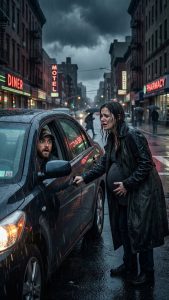
It was one of those rainy nights that make the whole city look shattered — streetlights smeared across wet asphalt like broken glass.
I’d been driving for almost ten hours when I saw her.
She was standing on the corner of the main avenue, drenched from head to toe, one hand clutching her belly, the other raised in a desperate attempt to stop a car that never seemed to come.
Before I could roll down the window and ask anything, she yanked open the back door and climbed in, shaking.
“Please, please,” she gasped, her voice cracking. “I need to get to San José Hospital. The baby’s coming.”
I met her eyes in the rearview mirror.
She couldn’t have been more than twenty-five. Her face was twisted with pain, her hair stuck to her cheeks, rainwater and tears indistinguishable.
“Get in, get in,” I said quickly. “Relax, we’ll get there.”
I pulled out into traffic, careful but fast. Every red light felt personal, like it was mocking us. In the back seat, she breathed in ragged bursts, trying to ride out the contractions.
“What’s your name?” I asked, more to keep her focused than anything.
“Carolina,” she panted. “Oh God… it hurts so much.”
“It’s almost time, Carolina. Try to breathe like they showed you, okay?”
“I didn’t go to any classes,” she choked out. “I couldn’t… I don’t have anyone. Her father left when he found out I was pregnant.”
Something tightened in my chest. I thought of my own daughter — about her age, with her whole life ahead of her. If she were alone in a strange city, terrified and in labor…
“Hey,” I said gently, “you’re not alone right now. You have me. We’re going to make it, I promise.”
The rain turned the city into a blur of red and white reflections, but I knew those streets like the back of my hand. Twenty years in that taxi had taught me every shortcut. I cut through side roads, side alleys, anywhere that might shave off a minute.
Behind me, Carolina whimpered.
“I won’t be able to pay,” she blurted suddenly. “I used everything I had on the apartment deposit. I… I’m so sorry.”
“Forget the fare,” I said without thinking. “The only thing that matters is you and that baby getting there safely. We’ll figure out the rest later.”
When we finally screeched up to the hospital entrance, I didn’t even park properly. I left the engine running and ran inside, shouting for help. Two nurses came rushing out with a wheelchair and gently lifted her out of the back seat.
As they wheeled her toward the automatic doors, she twisted around.
“Wait! What’s your name?” she called.
“Roberto!” I yelled back. “Roberto Méndez! But don’t worry about that now. Just focus on your baby!”
The doors slid shut between us, swallowing her cries and the bright corridor light.
I stood there for a moment in the rain, breathing hard, water soaking through my shirt. Then I went back to the taxi, turned off a meter I had never started, and drove home with the image of that girl — alone, terrified, about to become a mother — fixed in my mind.
Days passed.
I thought about her more than I expected. I wondered if she had to give birth alone. If the baby was all right. If someone was there to hold her hand when the contractions became too much.
Then, three weeks later, my phone rang.
Unknown number.
“Mr. Roberto Méndez?” a woman’s voice asked.
“Yes,” I said, heart already picking up. “Who’s speaking?”
“It’s Carolina. From the taxi… from that night. Do you remember me?”
I almost laughed. “Of course I remember. How are you? How’s the baby?”
“We’re fine, thank God,” she said, and I could hear the smile in her voice. “I had a little boy. His name is Matías. Mr. Roberto, I… I’d really like to see you. There’s something important I want to ask.”
We agreed to meet at a small park near the hospital.
When I arrived, I saw her right away — sitting on a bench, a stroller beside her. She looked different now. Still young, still fragile in a way, but more grounded. There was a peace in her posture that hadn’t been there that night in the rain.
“Mr. Roberto,” she said, standing up. “This is Matías.”
I leaned over the stroller and saw him — tiny, asleep, fists tucked up near his cheeks like he was still trying to remember the comfort of the womb.
“He’s beautiful, Carolina,” I said, voice catching a little. “Congratulations.”
She looked at me with tears glistening in her eyes.
“You saved me that night,” she said softly. “You didn’t just get me to the hospital. You made me feel… like I wasn’t completely alone. That meant more than you know.”
“I just did what anyone would have done,” I replied, suddenly shy.
She shook her head firmly. “No. Five taxis drove past me before you. Five. They saw a pregnant woman in the rain and kept going.” She swallowed. “You were the only one who stopped.”
She took a slow breath, then bent down and carefully lifted Matías from the stroller. Cradling him for a moment, she stepped closer and gently placed him in my arms.
“Mr. Roberto… would you like to be his godfather?”
I went still.
His warmth against my chest, his tiny hand resting on my shirt, the gentle weight that felt so small and yet… so enormous.
“Carolina, I…” I could barely get the words out.
“Please,” she whispered. “I have no one else here. My parents live far away and barely talk to me since I got pregnant. His father… disappeared. I want my son to grow up knowing there are men in this world who are kind and decent. Men like you.”
Matías’ little fingers curled around one of mine with surprising strength.
The lump in my throat turned into a wave.
“It would be an honor,” I managed, my voice breaking.
Carolina covered her mouth with her hand as tears spilled over.
“Thank you,” she repeated. “Thank you, thank you…”
The baptism was simple, held in a small neighborhood chapel with peeling paint and a warm-hearted priest. I brought my wife and my daughter. They fell in love with Matías the second they saw him.
Life moved forward after that, but it never went back to how it was before that rain-soaked night.
Carolina and I stayed in touch. I helped her find a better job. My wife collected baby clothes and toys our grandchildren no longer used and passed them along. On my days off, I stopped by their little apartment with groceries or just to hold Matías for an hour while Carolina rested.
Sometimes, late at night, driving through the city with the rain drumming on the roof of the taxi, I catch sight of someone alone on the sidewalk — someone with their hand raised, hoping a car will stop.
And I remember her.
Soaked. Shaking. One hand on her belly.
Afraid she would have to face everything alone.
One free ride, on a night I could have easily kept driving.
Now, on Sundays, when I take Matías to the park and he runs toward me with his short legs, shouting “¡Padrino!” in that bright little three-year-old voice, I know the truth:
That ride was the most valuable I’ve ever given in my entire career.
Because in the end, what matters isn’t the fares on the meter.
It’s the lives we touch — quietly, unexpectedly — on nights when someone needs us to stop.