
My parents threw me out on Christmas Day with absolutely nothing not even the chance to grab a coat telling me flatly, “You can’t survive on your own.”
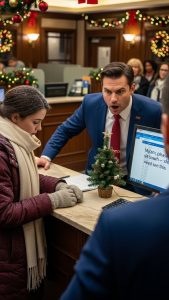
Frightened and freezing, I went straight to the bank to try the old card my grandfather once gave me “for emergencies.” The branch manager went pale when he saw the account, whispering, “Ma’am, please take a seat—you need to see this.” What appeared on the screen left me breathless.
My parents pushed me out the door without hesitation – no clothes, no bag, not even the little wooden box where I kept memories from childhood.
“You’re helpless without us,” my mother spit out, gripping the doorframe as if letting me stay inside one more second was unbearable. “You’ve never done anything by yourself.”
My father didn’t need to raise his voice. He stood behind her with his jaw locked and arms crossed, as though he’d already stamped FAILURE across my forehead. When I reached for my backpack on the stairs, he stepped between us.
“Leave it,” he said coldly.
“It’s mine,” I whispered.
“Everything under this roof belongs to us,” he replied. “Everything.”
The door slammed, final and absolute.
Outside, neighbors’ Christmas lights flashed cheerfully mocking me with their warmth. My fingers trembled around my phone as I tried calling someone—anyone. My best friend. My aunt. No answers. The winter air stung my face, and I forced myself not to cry; tears wouldn’t fix survival.
Then I remembered my grandfather’s card.
The summer before his stroke, he’d slipped it to me quietly – an old bank card in a plain envelope with my name on it. “Keep this,” he’d murmured. “For when the world pushes you down and won’t let you get back up.”
I’d never dared use it. It felt like admitting defeat.
Now defeat was all I had.
The only place open with holiday hours was the Hastings & Rowe Bank downtown. By the time I got there, my shoes were soaked and my fingers numb. I stepped inside, trying to look like someone who didn’t just get thrown out of her home.
“I need to withdraw something,” I told the teller, sliding the old card across the counter. “Anything. My accounts are locked.”
She scanned the card, and something shifted in her expression like she suddenly didn’t know how to talk to me.
“One moment,” she said, standing abruptly.
I sat in the lobby, heart rattling in my chest as people rushed by with last-minute cards and deposits. After what felt like an eternity, the branch manager approached. His name tag read ELIAS BURNS, and his face was unusually tense.
“Ma’am,” he said quietly, “please come with me.”
Not to the counter. To his office.
He closed the door, moved the computer monitor away from me, then hesitated and turned it back.
“Please sit,” he said, voice barely above a whisper. “You need to see this.”
My stomach knotted. “What is it?”
He typed several codes, opened a file, then swung the screen to face me.
The number that appeared wasn’t a balance.
It was life-changing wealth.
For a moment, my brain simply refused to interpret the digits. The screen displayed a trust account under my name—FIONA HART—with multiple investment portfolios, property holdings, and sub-accounts branching beneath it.
And right at the top was a balance I could not comprehend.
“Is this real?” I choked out.
Elias nodded. “Every cent.”
“I’ve never had money,” I stammered. “I don’t even have my own debit card anymore.”
“That’s because this isn’t a regular bank account,” he explained carefully. “It’s a trust. Established by your grandfather. You are the sole beneficiary.”
My breath caught. “Grandpa Walter.”
He nodded again. “It remained locked until a specific activation condition was met.” He tapped a highlighted entry. “It was triggered this week.”
Christmas week.
“What was the condition?” I asked.
He clicked on a note, and my heart twisted as I read:
Release requirement: Beneficiary no longer living at registered family residence. Verification method: third-party confirmation.
“I… I don’t understand,” I whispered.
Elias took a breath. “It means your grandfather designed this trust to become available only once you were no longer living under your parents’ authority. He wanted to prevent them from controlling the funds—or you.”
My throat burned.
“There’s more,” he added softly. “Attempts were made to access the trust.”
My heart lurched. “Attempts by who?”
He pulled up the logs.
AUTHORIZED REQUEST — DENIED: Thomas Hart
AUTHORIZED REQUEST — DENIED: Elaine Hart
My father. My mother.
I covered my mouth. “They tried to take it.”
“Several times,” Elias confirmed. “The trust blocked all attempts.”
Memories rewound sharply—years of discouraging me from independence, sabotaging my job interviews, taking my part-time wages, calling my goals “nonsense,” insisting I wasn’t capable of living on my own.
It wasn’t just harsh parenting.
It had been control.
“I want to withdraw cash,” I said shakily. “And I want them cut off completely.”
“We can issue an emergency card today,” he assured me. “And set up legal protections. But first, you should read the letter attached to your file.”
Elias opened a scanned document.

My grandfather’s handwriting spilled across the screen.
Fiona,
If you’re reading this, they’ve done what I feared. This trust is your doorway out. Walk through it. Don’t let them shrink you ever again.
– Grandpa
Tears blurred my vision.
“And one more thing,” Elias said quietly.
Another document opened—formal, notarized.
REVOCATION OF PARENTAL POWER OF ATTORNEY.
DESIGNATED TRUSTEE: FIONA HART.
My grandfather hadn’t just left money.
He left freedom.
I stepped out of the bank with a folder full of documents, a temporary card, and a cashier’s check. The cold no longer felt like an enemy. Fear didn’t own me anymore.
I booked a hotel room under my own name.
That night, my phone lit up with frantic messages.
Where are you?
Come home.
Stop acting ridiculous.
You have no money. You’ll come crawling back.
I stared at the screen, remembering the trust logs. Their rejection. Their attempts to break into what wasn’t theirs.
Then a final text:
Did you go to the bank?
My blood ran cold. They knew.
I didn’t reply. Instead, I forwarded the messages to an attorney recommended by the bank, asking for guidance and immediate legal protection.
The next morning, I wrote a list—something my parents always said I was incapable of doing:
A place of my own.
My own accounts.
My own insurance.
A safe deposit box.
School.
A future I chose.
The attorney called back with calm reassurance: “They have no rights to your trust. Document everything. If they escalate, we respond formally.”
Hearing the term financial abuse gave shape to years of confusion. It named what I’d lived under.
Three days later, my father left a voicemail, voice thin and shaking.
“Fiona… come home. We can talk.”
But family doesn’t shove you into the cold and then claim love when the money isn’t theirs.
I deleted the voicemail.
Building a new life wasn’t easy. Wealth doesn’t erase trauma, but it gives you choices—and choices are the first bricks of independence.
That Christmas marked the first day I stepped into the world as someone unowned, unclaimed, and finally free to grow.